

A solid digital marketing strategy template isn’t just a checklist; think of it as the architectural blueprint for everything you do online. It’s what separates deliberate, data-driven actions from just throwing things at the wall to see what sticks, saving you a ton of time and money in the process. Our team is here to provide the actionable insights you need to build a plan that truly performs.
Building Your Foundation, Not Just Filling in Blanks

It’s always tempting to dive straight into the fun stuff, like crafting social media posts or launching a cool ad campaign. We get it. But without a solid foundation, those efforts are rudderless and rarely make a real impact. A truly effective strategy starts by getting crystal clear on your “why” long before you ever touch the “how.”
This all begins with your core business mission and vision. What’s the fundamental reason your business exists? What kind of change or impact do you want to have in the long run? Nailing these down gives every marketing move you make a real sense of purpose.
Setting Goals That Actually Guide You
Goals like “increase sales” or “get more followers” are too vague to be useful. To build a genuine roadmap, you need to set SMART goals: that’s Specific, Measurable, Attainable, Relevant, and Time-bound. This simple framework turns fuzzy wishes into concrete targets.
Just look at the difference it makes:
- Vague Goal: “Increase website traffic.”
- SMART Goal: “Increase organic website traffic by 15% over the next three months by publishing one new search-optimized blog post each week.”
See how the second one gives you a clear finish line, a deadline, and the exact steps you need to take? It creates accountability and makes it easy to know if you’ve actually succeeded. If mapping this out feels like a lot, our team is always ready to offer professional advice to help you build this crucial framework. Just reach out, and we can help you set goals that drive real growth.
Perform a Candid SWOT Analysis
Before you plan your next move, you have to get brutally honest about where you stand right now. A SWOT analysis is a classic for a reason—it’s a straightforward but incredibly powerful way to examine your Strengths, Weaknesses, Opportunities, and Threats.
A candid SWOT analysis is non-negotiable. It forces you to look beyond your own assumptions and see your business from a market perspective, revealing hidden advantages and potential roadblocks before they become major issues.
This analysis makes sure your strategy is grounded in reality, not just wishful thinking. For instance, if you’re a smaller operation trying to grow, you might find some great ideas in this guide on creating a digital marketing strategy tailored for small businesses.
Identifying Your Unique Value Proposition
So, what really makes you different from everyone else out there? Your Unique Value Proposition (UVP) is the core promise you make to your customers—it’s the reason they should pick you over the competition.
Your UVP needs to be clear, concise, and woven into every piece of marketing you create. Is it your legendary customer service? Your game-changing product features? Or maybe your unbeatable pricing? Defining this from the get-go ensures your messaging is always consistent and compelling.
Taking the time to build this foundation is easily the most important part of creating a marketing strategy that delivers real, measurable results.
Zeroing In On Your Ideal Customer and Competitors
Great marketing should feel like a one-on-one conversation with exactly the right person. To make that happen, your digital marketing strategy needs to go way beyond basic demographics like age or where someone lives. The real insight comes from understanding their psychographics—what they believe, what they’re trying to achieve, and what’s getting in their way.
This is all about building buyer personas that feel like actual human beings. What are their biggest headaches at work? What are their career aspirations? Where do they hang out online after a long day? Answering these questions is the difference between shouting into the void and delivering a message that truly connects.
Crafting Detailed Buyer Personas
The whole point here is to paint a crystal-clear picture of who you’re talking to. This isn’t just a fun creative task; it’s the foundation for your content, your brand voice, and even the channels you decide to focus on. It makes sure you’re solving real problems, not just listing product features.
So, where do you get this intel? It’s easier than you think.
- Simple Surveys: Tools like Google Forms are perfect for polling your email list or social media followers. Ask them directly about their biggest challenges and goals.
- Social Media Listening: Dive into the communities where your potential customers live online. Check out relevant hashtags, Facebook groups, or Reddit threads. Pay close attention to the language they use and the questions they keep asking.
- Review Mining: Scour the reviews for your products—and your competitors’ products, too. What do people rave about? What drives them nuts? This is unfiltered feedback, and it’s pure gold.
To really nail this down, using an ideal customer profile template gives you a solid framework. It helps you organize all that research into a practical, shareable document so your entire team is on the same page about who you’re trying to reach.
Conducting a Sharp Competitive Analysis
Once you know who you’re talking to, you have to figure out who else is trying to get their attention. A competitive analysis isn’t about blindly copying what others are doing. It’s about spotting the gaps in the market that your brand can uniquely fill.
First, identify your real competitors. I’m not just talking about the big household names. Think about the smaller, niche players who might be stealing a slice of your audience. Take a good look at their entire digital footprint. What’s their core message? Where are they most active on social media? What content are they creating, and is it actually working?
By understanding the conversation your audience is already part of, you can figure out what’s missing. That’s your opening to position your brand as a necessary and distinct voice.
This analysis is where you find your opportunities. Maybe all your competitors are bogged down in technical jargon, which means you can swoop in with a more approachable, human tone. Or perhaps they’ve completely written off a platform like TikTok, where your target audience is spending hours every day. These are the kinds of insights that elevate a good marketing plan into a truly winning strategy.
Choosing Your Marketing Channels and Tactics
Alright, you’ve figured out your business goals and have a crystal-clear picture of your ideal customer. Now for the fun part: deciding where and how to actually connect with them. This is where your strategy gets legs and starts moving. The trick isn’t to be everywhere at once; it’s to be in the right places, consistently and effectively.
A classic rookie mistake is spreading resources too thin across a dozen different platforms. This just waters down your message and burns through your budget with little to show for it. Our advice? Focus on mastering one or two channels where you know your audience hangs out, then expand from there.
This simple flow chart really drives the point home—your audience data should be the roadmap that leads you directly to your best channels.
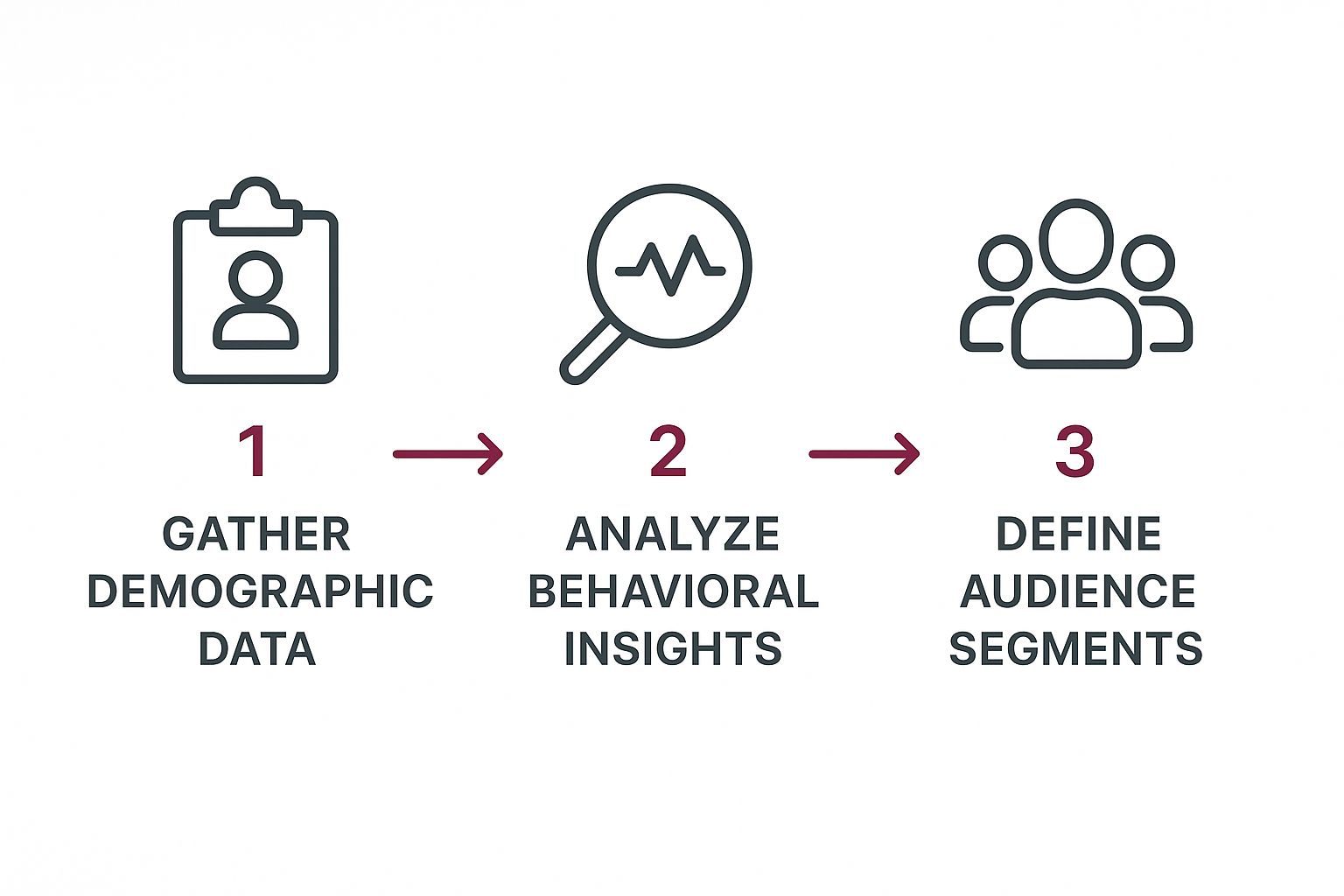
Think of it this way: the research you’ve done isn’t just a box to tick; it’s a direct line to the most impactful marketing channels for your specific business.
A Breakdown of the Core Digital Channels
Every digital marketing channel has its own personality and strengths. Getting to know them helps you build a mix that works in harmony to hit your goals. Let’s walk through the heavy hitters.
Search Engine Optimization (SEO)
We often call SEO the long game. It’s the craft of getting your website to pop up on Google when people are actively searching for what you offer. It doesn’t deliver overnight results, but the traffic it builds is sustainable and authoritative. Unlike a paid ad that vanishes when you stop paying, a well-optimized piece of content can keep delivering value for years.
- Primary Goal: Increase organic visibility and drive qualified traffic.
- Key Metrics: Keyword rankings, organic traffic volume, and conversion rates from organic search.
- Best For: Businesses that want to build a lasting, credible source of leads and brand authority over time.
Getting found in local search is a whole other level of the game. If that’s a priority, our dedicated team has deep experience in creating a powerful SEO strategy to get you noticed by the customers right in your neighbourhood.
Content Marketing
This is all about creating and sharing genuinely useful stuff—blog posts, videos, guides, you name it—to attract and hold the attention of your target audience. You’re not just shouting about your products; you’re solving problems and providing real value. That’s how you build trust and turn followers into customers.
Content marketing isn’t about the hard sell. It’s about becoming the go-to resource in your niche. When you consistently deliver value, people will naturally think of you when they’re ready to buy.
Content marketing is absolutely essential. Recent stats from 2025 show that even with over 50% of marketing budgets flowing into paid ads, content delivers a massive ROI. A staggering 84% of B2B marketers use it successfully for brand awareness. Specifically, blogs (used by 76% of marketers) and short-form interactive videos (which can boost conversions by up to 80%) are crushing it right now. It just goes to show that people crave authentic, helpful content.
To help you choose the right channels for your goals, here’s a framework we often use with clients.
Marketing Channel Selection Framework
This table breaks down the core digital marketing channels to help you decide which are best suited for your business goals, target audience, and resources.
| Channel | Primary Goal | Key Metrics | Best For |
|---|---|---|---|
| SEO | Long-term organic growth, brand authority | Keyword rankings, organic traffic | Building a sustainable lead source |
| Content Marketing | Building trust, audience engagement | Time on page, social shares, leads | Establishing expertise and nurturing leads |
| PPC Advertising | Immediate traffic, lead generation | CTR, CPC, conversion rate | Quick wins, promotions, testing offers |
| Email Marketing | Nurturing leads, customer retention | Open rate, click-through rate, conversions | Communicating directly with an interested audience |
| Social Media | Brand awareness, community building | Engagement rate, reach, follower growth | Connecting with audiences on a personal level |
Think of this as a starting point. Your perfect mix will depend on your unique situation, but this should give you a clearer picture of where to begin.
Deciding on Paid vs. Organic Tactics
The next piece of the puzzle is finding the right balance between your paid and organic efforts. They serve different purposes but work best when they complement each other.
Pay-Per-Click (PPC) Advertising
PPC, which covers everything from Google Ads to ads on social media, is like flipping a switch for traffic. You get to put your message right in front of a highly targeted audience, and you only pay when someone clicks. It’s brilliant for launching a new product, running a special promotion, or anytime you need to see results, fast.
- Primary Goal: Drive immediate, targeted traffic and generate leads quickly.
- Key Metrics: Click-through rate (CTR), cost per click (CPC), and conversion rate.
- Best For: Businesses that need quick wins, have a specific offer to promote, or want to test messaging.
Email Marketing
Email is the unsung hero of digital marketing. It’s one of the most powerful ways to nurture relationships and drive sales because you’re talking directly to people who have already raised their hands and said they’re interested. It’s perfect for sharing updates, offering exclusive content, and guiding subscribers toward a purchase.
As you map out your channels, drawing on insights from a well-crafted effective marketing strategy for small business success can make all the difference in ensuring your plan is both realistic and impactful.
Feeling a bit lost in all the options? That’s perfectly okay. Figuring out the right channel mix is a big task. Our team is here to help you build a plan that gets you the maximum impact for your budget. Just reach out, and we can start mapping it out together.
Allocating Your Marketing Budget and Resources

Let’s be honest: a strategy without a budget is just a wishlist. This is where your big ideas meet the real world, turning ambitious goals into a concrete action plan. Figuring out how to slice the pie—allocating money, time, and people across your channels—is what makes a digital marketing strategy template truly powerful.
There’s no magic number for what you should spend, but there are definitely smart ways to figure it out. The goal is to build a realistic, flexible budget that actually helps you hit your targets without burning cash. Don’t let the numbers scare you; getting this part right is incredibly empowering.
How to Choose Your Budgeting Model
The way you decide on your total marketing spend will look very different depending on whether you’re a scrappy startup or an established company. Let’s walk through a couple of common models to see which one feels right for you.
A straightforward starting point for many is the percentage-of-revenue model. You simply earmark a fixed percentage of your total (or projected) revenue for all things marketing. It’s easy to calculate and ensures your spending naturally scales as your business grows.
For a more strategic approach, the objective-based model is our personal favourite. This is where you work backwards from your goals. For instance, if you need to generate 50 new leads every month, you calculate the cost of all the activities required to hit that number—think ad spend, content creation hours, and software subscriptions.
Projecting Your Spend and Return on Investment (ROI)
Forecasting your costs and estimating your return on investment (ROI) brings a whole new level of confidence to your planning. We always recommend starting by breaking down the expected costs for each marketing channel you’ve decided to pursue. Remember, this isn’t just about ad spend; you have to account for all the resources involved.
Your budget allocation might include line items like:
- Content Creation: What will you pay your writers, designers, or video producers?
- Ad Spend: The direct cash you’ll put into Google Ads, LinkedIn, or other PPC and social media platforms.
- Marketing Tools: Monthly or annual subscriptions for your SEO software, email marketing platform, and analytics tools.
- Team Resources: The cost of your in-house team’s time (salaries) or payments to freelancers and agencies.
A budget isn’t a “set it and forget it” document. Think of it as a living thing. You need to constantly monitor, analyze, and shift funds to the channels that are actually delivering results. Flexibility is your best friend here.
Of course, the competitive landscape plays a huge role in your costs. Global digital ad spend is projected to soar past $765 billion in 2025. In hyper-competitive markets like California, the average cost-per-action (CPA) for paid search can hit $49, while display ads are even higher at $75. This reality makes precise, data-driven budgeting an absolute must-have in any digital marketing strategy template. If you want to dive deeper into the numbers shaping marketing today, check out these digital marketing insights.
Making Every Dollar Count
With a clear budget in hand, the name of the game is maximizing your impact. If you’re running paid campaigns, for example, a professional setup isn’t a luxury—it’s essential. Our team can help with an expert Google Ads setup that ensures your ad spend is laser-focused on the right audience from day one.
The sample budget in our template is just a starting point. Your own breakdown should reflect what matters most to your business right now. If long-term organic growth is the priority, you’ll probably invest more in content and SEO. If you need leads in the door tomorrow, a bigger slice of the pie will go to PPC.
Feeling a bit stuck on where to start or how to structure your spending? That’s exactly why we’re here. Our team is ready to offer professional advice and a free estimate to help you build a budget that makes every single dollar work harder for you.
Measuring Performance and Optimizing Your Plan
Think of your marketing plan not as a static document you create once and then file away, but as a living, breathing blueprint for your business. It’s meant to evolve. The real magic happens when you get into the rhythm of measuring what’s working, analyzing the results, and tweaking your approach.
This is where you stop guessing and start making smart, data-backed decisions. You’ll gain a crystal-clear picture of which efforts are actually moving the needle and which ones are just eating up your budget. Honestly, this cycle of testing and refining is the secret to sustainable growth.
Setting Up Your Marketing Dashboard
First things first, you need a single place to see what’s going on. A marketing dashboard doesn’t have to be some complex, expensive piece of software. Its entire purpose is to give you an at-a-glance view of your most important Key Performance Indicators (KPIs)—the very ones you identified earlier in your planning.
You can build a perfectly useful dashboard with something as simple as Google Sheets or get a bit more visual with a free tool like Looker Studio (formerly Google Data Studio). The specific tool isn’t nearly as important as what you choose to track on it.
Your dashboard needs to be all about your goals. For example, if your main objective is to generate more leads, you’ll want to keep a close eye on metrics like:
- Conversion Rate: What percentage of people visiting your website are actually filling out a form or taking that key action?
- Cost Per Lead (CPL): On average, how much are you spending to get one new lead in the door?
- Leads by Channel: A breakdown showing which of your channels (organic search, social media, paid ads, etc.) are bringing in the best leads.
By zeroing in on the numbers that directly impact your goals, you avoid the trap of “vanity metrics”—those numbers that look impressive but don’t actually contribute to your bottom line. If you need a hand setting up a dashboard that makes sense for your business, just reach out. Our dedicated team is always here to help you make sense of the data.
Essential Tools for Keeping an Eye on Performance
To get accurate information flowing into your new dashboard, you’ll need a couple of must-have tools. The good news? The most critical ones are free.
Google Analytics is absolutely non-negotiable if you have a website. It’s the industry standard for understanding how people find you and what they do once they’re on your site. You can track traffic sources, popular pages, user demographics—you name it.
Just as important are the built-in analytics on your social media platforms. Facebook Insights, Instagram Analytics, and LinkedIn Analytics are packed with valuable data on post reach, engagement rates, and who your followers are.
The real skill isn’t just collecting numbers; it’s about finding the story hidden in the data. For instance, a sudden drop in website traffic from Instagram might tell you it’s time to rethink your content strategy there or maybe reallocate your ad spend to a platform that’s performing better.
This constant feedback loop is what makes a digital marketing strategy so effective. It lets you replace assumptions with hard evidence, giving you the confidence to double down on what works and cut what doesn’t.
The Rhythm of Relentless Improvement
Data is completely useless if you don’t do anything with it. That’s why setting up a regular schedule for performance reviews is so critical—it’s how you turn insights into action. We usually recommend a monthly or quarterly review cycle, depending on how fast things move in your industry.
These review meetings shouldn’t just be about reading off a list of stats. The entire point is to ask “why” and “what’s next?”
- Why did our email open rates dip by 15% this month?
- What can we test next quarter to improve the conversion rate on our top blog post?
- Should we shift more of our budget to the Facebook campaign that’s giving us a much lower CPL?
This process ensures your digital marketing plan stays relevant and powerful. It’s your chance to refine tactics, adjust your messaging, and move your budget around with confidence. For businesses that want to keep a steady and engaging presence without all the guesswork, exploring our monthly social media content packages can be a huge help.
At the end of the day, this commitment to continuous improvement is what separates successful marketing from a whole lot of wasted effort. If you ever feel buried in data or just aren’t sure what the next best move is, our team is here to offer professional advice and a free estimate to help you get the most out of your plan.
Your Digital Marketing Questions Answered

As you start piecing together your digital marketing strategy, you’re bound to have some questions. That’s a good thing. Asking the right questions now ensures the template you build becomes a powerful tool for growth, not just another document that collects dust.
Over the years, our dedicated team has heard a lot of the same queries from business owners trying to get this right. Let’s tackle some of the most common ones head-on with some actionable advice.
How Often Should I Update My Marketing Strategy?
Treat your strategy like a living, breathing part of your business. The digital space changes so fast that a “set it and forget it” approach just doesn’t work.
We recommend doing one major overhaul every year. This is your chance to step back, look at the big picture, and make sure your marketing goals are still perfectly aligned with your main business objectives for the upcoming year.
But don’t wait 12 months to make adjustments. You need to be checking in on a quarterly basis.
A quarterly review is your opportunity to be proactive, not reactive. It’s where you can spot a channel that’s not pulling its weight before you sink more budget into it, or find a surprise win that you can double down on right away.
For example, if you notice engagement on a key social platform has been dropping for two months straight, your quarterly check-in is the perfect time to dig into why and shift those resources somewhere more effective. That constant fine-tuning is what keeps a strategy sharp.
What Is the Biggest Mistake in Marketing Planning?
Hands down, the single biggest mistake we see is building a plan without a crystal-clear, deeply understood audience in mind. It’s that classic “spray and pray” method where you try to be everything to everyone, and in the end, your message connects with no one. It’s an incredible waste of time and money.
A truly effective strategy is built on a laser-focused understanding of your niche audience. You need to know their pain points, their challenges, and where they hang out online.
Getting this foundation right makes every other decision a whole lot easier:
- Choosing Your Channels: You’ll know exactly which platforms to focus on because you know where your audience already spends their time.
- Creating Your Content: You can craft content that solves their specific problems, instantly making your brand more valuable to them.
- Nailing Your Tone: You’ll know how to speak their language, which is crucial for building real trust and rapport.
The buyer persona work we talked about earlier is your best defence against this pitfall. If you’re struggling to define who you’re really talking to, our dedicated team can definitely help you get that clarity. Just reach out for some professional advice.
Can This Template Work Without a Large Budget?
Absolutely. A good strategy isn’t about the size of your budget; it’s about how smart you are with the resources you have. In fact, a limited budget forces you to be more creative and focused, which often leads to much better marketing.
The key is to prioritize high-impact, low-cost activities that deliver long-term value.
- SEO: Investing your time in search engine optimization is one of the most cost-effective ways to build a steady stream of qualified traffic over the long haul.
- Content Marketing: A library of genuinely helpful blog posts or downloadable guides positions you as an expert and attracts leads organically.
Instead of stretching a small budget thin across five different channels, a more strategic approach is to pick one or two platforms where your ideal customer is most active and really own that space. A focused, well-executed plan will always beat a huge budget with no real direction.
Feeling a bit stuck on how to make your budget stretch? Just reach out for a free estimate. Our team is here to help you put together a plan that gets you the biggest bang for your buck, no matter the size. Our dedicated team is ready to help.
At Sugar Design Group, we believe a great strategy is the foundation of business growth. Our dedicated team is here to provide professional advice and help you build a marketing plan that delivers real results. Let’s create your standout online presence together.