

Getting into ecommerce website development in Vancouver is one of the biggest steps you can take to grow your business today. A well-built online shop puts you directly in front of the city’s digitally-savvy customers, opening up new ways to make money that a physical store just can’t match. This guide will walk you through building an online presence that really works, with actionable insights from a dedicated team ready to help.
Why Your Vancouver Business Needs an Online Shop
In a city as vibrant as Vancouver, a brick-and-mortar location alone isn’t enough. Your customers are already online, searching for local goods and services on their phones and computers.
A great ecommerce website acts like a salesperson working 24/7, reaching people across the Lower Mainland and beyond long after you’ve closed for the day. Think of your site as your flagship store on Robson Street—it needs to be easy to find, welcoming, and simple to shop in. Without it, you risk being invisible to a massive audience that’s ready to buy.

The shift to online shopping isn’t temporary; it’s now the standard. Canadian ecommerce is growing rapidly, creating a huge opportunity for Vancouver businesses ready to act.
A professional ecommerce site doesn’t just sell products. It builds your brand, creates loyal customers, and provides valuable insights about your audience. With ecommerce sales in Canada projected to surpass CAD $120 billion by 2025, businesses that hesitate may miss out. This makes investing in smart ecommerce website development essential.
You can get a deeper look at Canada’s e-commerce trends in this detailed analysis on consumer behaviour.
What’s Next on Your Path to Online Success?
Diving into ecommerce can feel overwhelming, but with a clear strategy, the process is manageable. A strong plan can:
-
Widen Your Reach: Attract customers across Vancouver, British Columbia, and beyond.
-
Boost Your Sales: Your store is open 24/7, catching late-night and early-morning shoppers.
-
Provide Smart Insights: Track products, customer behavior, and sales trends to inform decisions.
Building a successful online store requires specific skills, but you don’t have to do it alone. Our dedicated team offers professional advice and a free estimate to help you get started.
Choosing the Right Ecommerce Platform
Picking an ecommerce platform is a lot like choosing the foundation for a new building. You need something solid enough to support you right now, but also flexible enough to let you add a second story later on. For any Vancouver business stepping into the online world, this is easily one of the most important decisions you’ll make.
Instead of getting lost in a sea of technical jargon, the best way forward is to focus on what your business actually needs to thrive. The big names like Shopify, WooCommerce, and Magento all have their strengths, but the “best” one is the one that fits your specific operation like a glove. The choice you make sets the stage for how you’ll manage, market, and grow your store for years to come.
Evaluating Your Core Business Needs
Before comparing platforms, identify your essential requirements:
-
Scalability: Can the platform grow with your business?
-
Ease of Use: How tech-savvy is your team?
-
Customization: Do you need a unique brand experience, or will a template suffice?
-
Budget: Consider both upfront costs and ongoing fees.
Align technology with your business vision. A well-chosen platform empowers growth rather than restricting it.
Comparing the Top Ecommerce Contenders
Here’s a practical overview for Vancouver businesses:
| Platform | Best For | Scalability | Ease of Use | Approx. Monthly Cost |
|---|---|---|---|---|
| Shopify | Startups and small businesses seeking an all-in-one solution | Good to Excellent | Very Easy | $39 – $399+ |
| WooCommerce | Businesses on WordPress or needing full control | Good | Moderate | $15 – $100+ |
| Magento | Large, complex operations with high sales | Excellent | Difficult | $2,000+ |
Shopify is ideal for fast launches and minimal technical headaches, with extensive apps for added features.
WooCommerce offers flexibility and full control if you’re already on WordPress.
Magento (Adobe Commerce) is enterprise-level, built for large catalogs but requires technical resources and higher costs.
Remember, selecting the right payment gateway is equally critical, as it affects transaction fees and customer experience.
Designing an Unforgettable User Experience
In a market as vibrant as Vancouver’s, a pretty website is just the price of entry. The real magic, the thing that turns visitors into loyal customers, is an experience so smooth and intuitive they actually enjoy shopping with you.
Think of your website like a boutique on Granville Island. Is it easy to wander through? Are your products displayed in a way that makes people want to pick them up? Is paying a breeze? That’s the feeling we’re aiming for.
A great user experience directly translates into more sales and happier customers. The moment someone lands on your site, they’re making a snap judgment. In fact, research shows that 94% of first impressions are tied to design, and people form that opinion in just 50 milliseconds.
For ecommerce website development in Vancouver, where your customers are sharp and tech-savvy, there’s no room for a clunky or slow site. If it’s frustrating to use, they’ll simply bounce to a competitor.
The Mobile-First Imperative
Let’s face it: more Vancouverites are shopping on their phones now than ever before. This isn’t just a trend; it’s the new standard. Designing for a small screen can’t be an afterthought—it has to be your starting point. A mobile-first approach means your site is fast, easy to navigate, and looks fantastic on any device.
This is about more than just making your desktop site smaller. It’s about completely rethinking the layout to give mobile users exactly what they need, right away.
- Simplified Navigation: Menus need to be clean and tappable, with obvious categories that guide people where they want to go.
- Thumb-Friendly Design: Important buttons, like “Add to Cart,” should be right where a thumb can easily reach them. No gymnastics required.
- Optimised Images: Product photos have to load quickly but still look amazing. A slow-loading image is a sale killer.
- Streamlined Forms: Keep checkout and contact forms short. Only ask for what’s absolutely necessary to avoid frustrating your customers.
Intuitive Navigation and High-Quality Imagery
Ever walked into a store where everything is a mess and you can’t find anything? You probably walked right back out. Your website’s navigation works the same way. It’s the digital signposting that guides customers from your homepage to the perfect product without any confusion.
At the same time, because your customers can’t physically touch the products, your photos have to do all the work. High-quality imagery builds trust and gives people the confidence to click “buy.” You need crisp, professional shots from multiple angles that truly showcase what you’re selling.
A great user experience isn’t just about how a site looks; it’s about making the customer’s journey as simple and enjoyable as possible. Every single element, from the menu to the product photos, shapes their impression of your brand.
If you’re building a new site or want to improve your current one, our website design services are focused on creating exactly these kinds of intuitive and visually compelling experiences. We’re here to offer professional advice to get you started.
The decision tree below shows how your business’s growth plans can influence which platform is the right fit—a crucial factor for the long-term user experience.
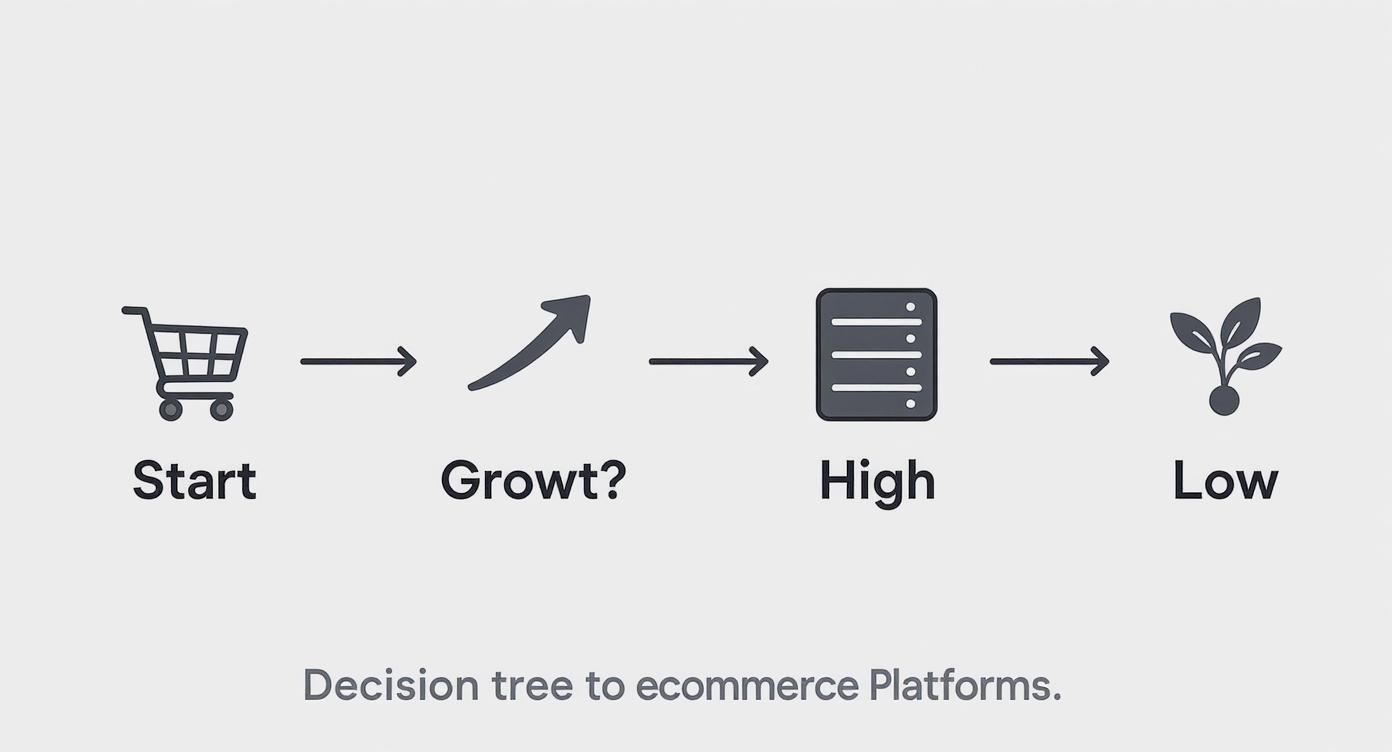
As you can see, businesses aiming for significant growth should probably start with a platform built to scale right from day one.
The Critical Role of Page Speed
Finally, let’s talk about the ultimate UX killer: a slow website. Vancouver users are not known for their patience. They expect your site to load in under 3 seconds. Any longer, and you risk losing almost half of your visitors before they’ve even seen what you have to offer.
Optimizing your site’s performance is a technical, but absolutely essential, part of modern ecommerce development. A fast, responsive site tells your customers you value their time and delivers the professional experience they expect.
Integrating the Right Features for a Modern Ecommerce Machine
A basic online store is just a digital catalogue with a buy button. A great one, however, is a full-blown sales and operations machine. The features you build into your site are what close that gap, turning a simple product listing into an experience that keeps customers coming back.
For any business trying to stand out, especially in a competitive market, thoughtful ecommerce website development in Vancouver is about so much more than a checkout page. It’s about building a smart, cohesive system where every feature makes shopping easier for your customers and running the business simpler for you.
Using AI to Personalize the Shopping Journey
Think about it: modern shoppers have little patience for scrolling through hundreds of products to find what they want. This is where artificial intelligence (AI) can step in and act like a personal shopper, putting items they’ll actually love right in front of them.
AI-driven product recommendations work by analyzing a visitor’s clicks, their past purchases, and even what similar shoppers have bought. Your site can then automatically feature the most relevant products, which is a proven way to boost your average order value and make customers feel understood.
Building Trust with Secure, Familiar Payment Options
Nothing torpedoes a sale faster than a clunky or suspicious checkout process. Integrating trusted, secure payment gateways isn’t just a good idea—it’s absolutely essential. This means offering a mix of options, from all major credit cards to digital wallets like Apple Pay and Google Pay, all running through a rock-solid, encrypted system.
When a customer sees those familiar payment logos, it’s an instant shot of confidence. It’s a small detail, but it’s a massive cornerstone of trust that tells them their financial information is in safe hands.
A seamless and secure checkout is one of the most powerful conversion tools you have. It removes the final barrier between a customer’s interest and a completed sale, reassuring them at the most critical moment.
Getting all these systems to talk to each other can feel overwhelming, but you don’t have to figure it out on your own. Our team is here to offer professional advice and a free estimate to help you build a platform that truly performs.
Streamlining Your Operations with Smart Inventory Management
Once your business starts to scale, trying to track your stock levels manually is a recipe for disaster. A solid inventory management system that plugs directly into your website is critical for avoiding the dreaded “oops, we oversold” email.
These systems automatically update your stock levels in real time the moment a sale is made. Better yet, they give you priceless data on what’s flying off the shelves, helping you make smarter buying decisions and keep your bestsellers from running out.
- Real-Time Syncing: Ensures your website’s stock count is always accurate, preventing sales of items you don’t have.
- Low-Stock Alerts: Automatically pings you when an item’s inventory gets low so you can reorder before it’s too late.
- Sales Reporting: Gives you a clear picture of sales trends, which makes forecasting future demand so much easier.
Ensuring Your Site is Accessible to Everyone with WCAG 2.1 AA Compliance
A truly successful ecommerce site is one that everyone can use, period. Following the Web Content Accessibility Guidelines (WCAG) 2.1 AA standards isn’t just a technical box to tick; it’s a fundamental part of reaching the widest possible audience.
This means designing your site so that people with disabilities, including those with visual or motor impairments, can browse, select, and purchase products without hitting a wall. True compliance goes deep into the code, covering things like colour contrast, keyboard-only navigation, and descriptive text for all your images.
This commitment to accessibility not only expands your potential customer base but also sends a clear message that your brand is inclusive. With the global e-commerce market projected to hit a staggering $6.4 trillion by 2029, you want everyone to be able to participate. It’s no surprise that 85% of business leaders are looking to AI to improve customer service, but in Canada, meeting accessibility standards like WCAG 2.1 AA is just as crucial for growth. You can learn more about current e-commerce trends and their impact to stay ahead of the curve.
Pulling all these pieces together—AI, payments, inventory, and accessibility—is what modern ecommerce website development in Vancouver is all about. It’s a complex puzzle, but our experienced and dedicated team is here to help you build a powerful, cohesive, and successful online store. Don’t hesitate to reach out for professional advice.
Winning Local Customers with Vancouver SEO
Getting your beautiful new ecommerce site live is a fantastic milestone, but it’s really just the starting line. Now, the people who matter most—your local customers right here in Vancouver—need to be able to find you. That’s where a smart, targeted local search engine optimization (SEO) strategy becomes your secret weapon for growth.
It’s not enough to rank for generic product names. To really make a dent in the local market, you have to connect with shoppers who are actively looking for what you sell, in their own neighbourhoods. This means getting specific and using tactics that capture motivated local traffic.
Mastering Your Google Business Profile
Think of your Google Business Profile (GBP) as your digital storefront. It’s often the very first thing a potential customer sees, popping up in Google Maps and the local search results. Having a fully decked-out profile isn’t just a good idea; it’s essential.
And I mean more than just listing your address and phone number. To truly stand out from the crowd, your profile needs to be a rich, helpful resource that makes it easy for customers to choose you.
- Show, Don’t Just Tell: Use high-quality photos of your products, your physical location (if you have one), and your team. This builds immediate trust and gives people a real sense of your brand.
- Be Hyper-Local: Clearly define the Vancouver neighbourhoods you serve, whether it’s Kitsilano, Mount Pleasant, or Gastown. This helps Google connect you with the most relevant local searchers.
- Keep it Fresh: Use Google Posts to share updates about new arrivals, sales, or special events. This sends a strong signal to Google that your business is active and engaged.
Building a Strong Local Footprint
Beyond Google, your business details need to show up consistently across other local websites and directories. Each listing acts like a digital signpost, pointing back to your website and cementing your connection to the Vancouver area.
A hyper-focused local SEO strategy is all about proving your relevance to a specific geographic area. It tells search engines that you are not just another online store, but an integral part of the local business community.
Consistency is key. Making sure your Name, Address, and Phone number (NAP) are identical across platforms like Yelp, Yellow Pages, and industry-specific sites is a huge trust signal for search engines. It confirms you’re a legitimate local business. If you’re looking for professional guidance, our experts can provide a free estimate for our Vancouver search engine optimization services.
Creating Content That Speaks to Vancouverites
Your website’s content needs to feel like it was written for a local. This is your chance to use the local lingo and address the unique needs of people living here, making your brand feel instantly familiar.
Don’t just target “women’s rain jackets.” Think about what a Vancouverite would actually type into Google.
- Neighbourhood Keywords: Create blog posts or pages targeting phrases like “same-day gift delivery in Yaletown” or “bike repair shop near Stanley Park.”
- Local Event Tie-ins: Write content that connects to local happenings. Think “What to Wear to the Vancouver Folk Music Festival” or “Gear Guide for the Grouse Grind.”
- Solve Local Problems: Acknowledge our city’s unique lifestyle. A blog post titled “The Best Waterproof Backpacks for a Rainy Vancouver Commute” will connect far better than a generic product description.
This kind of tailored approach shows you truly get the local market, making customers feel like you’re one of them. It’s how you build a loyal community, not just a customer list.
Finding the Right Vancouver Development Partner
Choosing an agency for your ecommerce website development in Vancouver isn’t like hiring a plumber. You’re not just looking for someone to fix a problem and leave. You’re looking for a long-term partner, a team that’s as invested in seeing your sales grow as you are.
Think of them as an extension of your own team. They should be there to offer guidance and support long after your site goes live. So, how do you find that perfect fit in a city packed with talented agencies? It starts by looking past the slick proposals and getting to the heart of their work and how they operate.
What to Look For in a Portfolio
A portfolio is more than just a gallery of pretty websites; it’s your first real piece of evidence. Don’t just glance at the homepages. Click around.
How does it feel to use their past projects? Do the pages load in a snap, or are you left waiting? Pull them up on your phone – is it a seamless experience, or a clunky mess? Most importantly, does the website actually feel like the brand it represents?
Look for a variety of work, especially within the ecommerce world. An agency that has built successful online stores for both a small local boutique and a larger, more complex operation shows they have the adaptability and skillset to handle whatever you throw at them.
Choosing the right partner means finding a team that truly gets your business goals and values. Their success should be tied directly to yours, creating a relationship built on mutual growth and trust.
We’ve built our reputation on a transparent process and a track record of real results for our clients. We’d love to show you what we can do, so feel free to reach out for a free, no-obligation estimate and we can chat about bringing your ecommerce vision to life with our dedicated team.
Key Questions to Ask Any Potential Agency
Before you sign on the dotted line, you need to talk to them. This conversation is less about grilling them on code and more about seeing if you can actually work together. Clear, open communication from day one is the foundation of any successful project.
Here are a few essential questions to get the ball rolling:
- Process: Can you walk me through your entire process, from the first meeting to launch day and what happens after? A team with a well-defined process is organized and knows what they’re doing.
- Communication: Who’s my go-to person on your team? How often will I hear from them? You need a clear line of communication to keep things moving forward without any surprises.
- Support: What happens after the site is live? What kind of ongoing support and maintenance do you offer? Your website is a living thing; it will need security updates and tweaks to keep it running smoothly.
- Expertise: Can you show me a case study of a project you’ve done that’s similar to mine? This is the best way to confirm they have experience with businesses just like yours.
Finding the right fit for your ecommerce website development in Vancouver is one of the most important decisions you’ll make. By digging into their past work and asking these kinds of questions, you’ll find a partner ready to help you build a powerful and profitable online store. If you want some professional advice, our team is here and ready to help you get started.
Your Top Ecommerce Development Questions Answered
Starting an ecommerce project always brings up a lot of questions. If you’re a business owner in Vancouver, you’re probably wondering about the same key details we hear from most of our clients before they dive in. Let’s get straight to the point and tackle those common queries so you can plan your next move with clarity.
Think of this as your practical guide to building an online store in our city.
How Much Does an Ecommerce Website Actually Cost?
This is always the first question, and the honest answer is, it really depends. The cost of ecommerce website development in Vancouver is tied directly to how complex your project is. A clean, simple store with a handful of products is going to be a lot less than a fully custom-built site with thousands of items and specialized features.
As a general ballpark, a professional ecommerce website built by a Vancouver agency can start around $5,000 and go up to $30,000+ for more ambitious projects. The price tag is really shaped by a few key things:
- Number of Products: The more products and variations you have, the more time it takes to set everything up correctly.
- Custom Features: Need a unique booking system or a product personalizer? Those special functions add to the development cost.
- Design Complexity: A completely custom, one-of-a-kind design is a bigger investment than a site built from a high-quality, pre-existing theme.
What Is a Realistic Project Timeline?
Just like the cost, the timeline is all about the scope of the work. A more straightforward Shopify or WooCommerce store using a pre-built theme can often be up and running in 4 to 8 weeks. That gives us enough time to handle the setup, load your products, integrate payment systems, and do thorough testing.
For larger projects with custom designs and complex features, you’re looking at a timeline of 3 to 6 months, sometimes more. That longer period accounts for deep-dive strategy sessions, wireframing, creating the custom design from scratch, development, and, of course, rigorous testing to make sure everything is perfect.
The smartest way to start is by clearly defining what you absolutely need your site to do. This helps a development partner give you a truly accurate timeline and cost estimate, so there are no surprises down the road.
If you’re just starting out, getting a handle on the basic steps is key. This handy guide on setting up an ecommerce website is a great resource for framing your project’s requirements.
What Happens After My Website Launches?
Getting your website live is a huge milestone, but it’s really just the starting line. What happens next is what determines your long-term success. You’ll need ongoing support to keep your site secure and running smoothly—think software updates, security scans, and regular backups.
Beyond the technical stuff, you have to get people to your site. This is where a solid marketing strategy comes in, driven by local SEO, great content, and digital ads. A good development partner won’t just build your site and disappear; they’ll offer support packages and strategic advice to help you grow.
Our dedicated team is here to walk you through the entire process. If you have more questions or you’re ready to chat about your project, just reach out. We’d be happy to provide some professional advice and a free, no-obligation estimate. Let’s build something great together.
At Sugar Design Group, we’re focused on turning your vision into a successful online store. Contact us today to get started.