

Personal reputation management is the process of taking control of how you’re seen online. It’s the hands-on work of monitoring what’s out there, addressing any negative content, and actively building a positive story that truly reflects who you are. Think of it as your digital first impression—and it’s more important now than ever. If you’re looking for actionable advice on how to start, our team is ready to provide the professional insights you need.
Why Your Online Reputation Is Your New First Impression

Before anyone ever meets you in person, they’ve likely already Googled you. That search has become the real first impression, and it happens long before you get a chance to shake their hand or tell your own story.
What turns up—whether it’s old social media posts, public records, your professional profiles, or news articles—paints a picture. This digital narrative can either open doors or slam them shut, affecting everything from job offers and business partnerships to your personal relationships. Consider this: studies show over 75% of users never click past the first page of search results. What shows up there holds incredible power.
Shifting from Bystander to Builder
Most people are passive bystanders to their own online story, letting their digital footprint grow without any real direction. But effective personal reputation management is about making a conscious shift from a reactive mindset to becoming an active builder of your digital self. It’s the difference between letting random, outdated bits and pieces define you and deliberately crafting a presence that highlights your true character and skills.
This isn’t about faking it or creating a false identity. It’s simply about making sure the information out there is accurate, fair, and reflects who you are today. This usually involves:
- Auditing your digital footprint to get a clear picture of what others see.
- Creating and sharing positive content that showcases your strengths and wins.
- Monitoring your name online to catch potential issues before they escalate.
- Tackling negative or false information with a smart, professional strategy.
Your digital reputation is one of your most valuable assets. It’s not just about damage control; it’s about building a strong, positive identity for your future. Taking a proactive approach is the only way to ensure your online story supports your real-world ambitions.
The Real-World Impact of Your Digital Self
A neglected online reputation has very real consequences. An unprofessional comment you forgot you made a decade ago could pop up during a background check for that dream job. Misleading information can break trust with a potential client.
On the flip side, a strong, positive online presence can position you as an expert in your field, attract incredible opportunities, and build instant credibility.
Getting this right requires a clear strategy. Building a positive identity is a deliberate process, but you don’t have to figure it all out on your own. If you aren’t sure where to start or you’re dealing with a particularly tough reputation issue, our dedicated team is ready to help. We offer professional advice and can guide you on your personal reputation management journey. Just reach out for a free estimate, and let’s start building the online presence you deserve.
How to Audit Your Digital Footprint
Before you can start shaping your online reputation, you need a clear picture of what’s already out there. Think of it like a home renovation: you wouldn’t start knocking down walls without first inspecting the foundation. A thorough audit of your digital footprint is that crucial first step for any real personal reputation management.
This isn’t just about a quick Google search of your name. It’s a deep dive to uncover every bit of information that shapes your online story—from old social media profiles and forum comments to public records and articles that mention you. The goal is simple: to see yourself exactly how a potential employer, client, or even a new date would.
Starting Your Self-Audit
The easiest place to start is with a search engine, but you need to be strategic to find everything. Here’s some actionable advice to get you started:
- Be Specific with Your Searches: Don’t just type in your name. Use combinations like
"Your Name" city,"Your Name" profession, or"Your Name" old company. Putting your name in quotation marks forces the search engine to look for that exact phrase. - Check More Than One Search Engine: Google might be the biggest player, but you’d be surprised what pops up on Bing or DuckDuckGo. A complete audit means checking them all.
- Don’t Stop at Page One: You have to dig deeper. That embarrassing comment on page three of the search results might just be one algorithm update away from hitting the front page.
As you find things, start sorting them. Is it positive, negative, or just neutral? Is it something you can control, like your own blog, or something you can’t, like a news story? This list will be the roadmap for your entire strategy.
The infographic below walks you through the process, from those first searches to the final analysis.
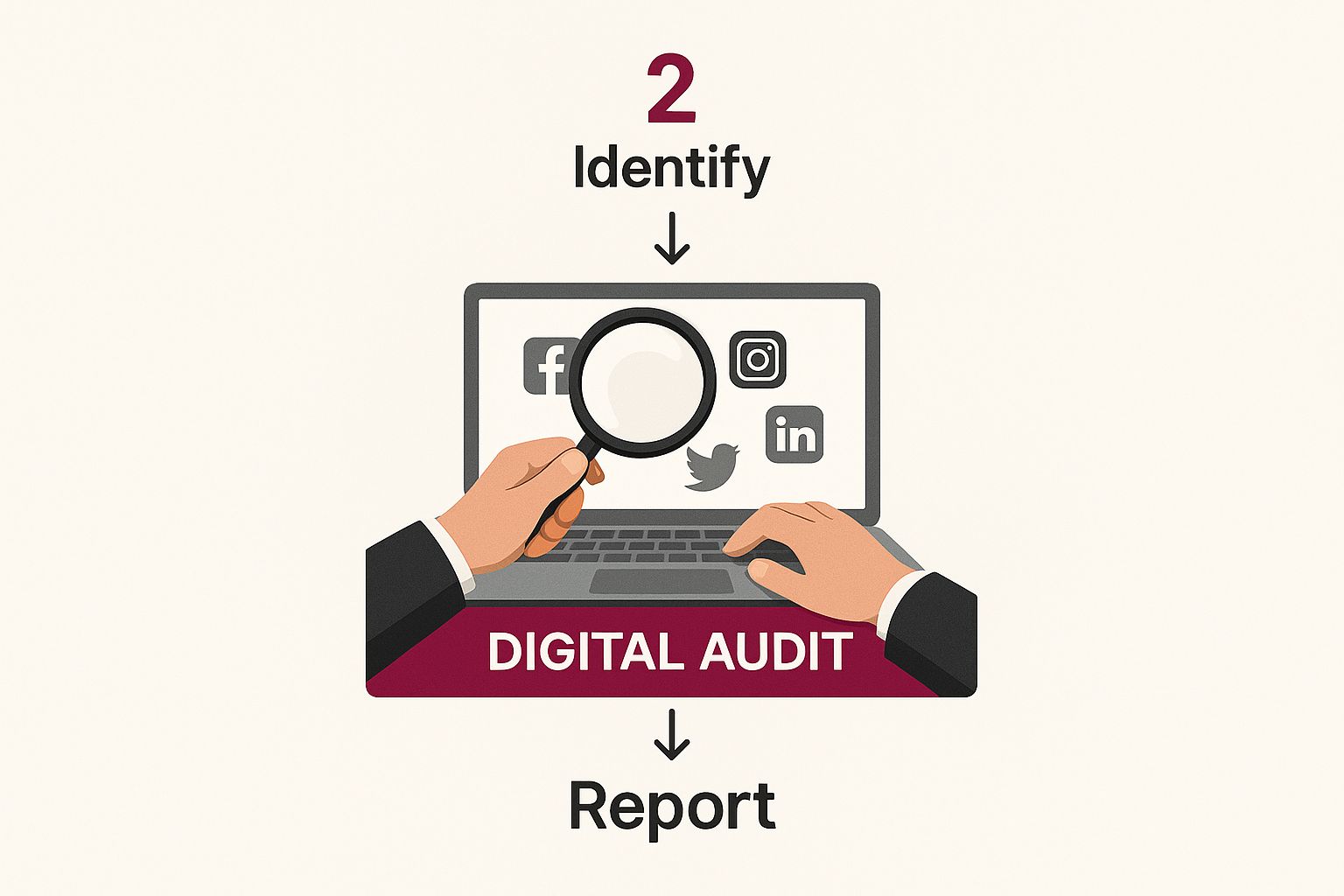
This visual guide breaks down how a digital audit is really a structured investigation of your online presence, helping you spot both your strengths and your weaknesses.
To get you started, here’s a checklist to guide your own audit. It’ll help you systematically review your online presence and pinpoint any areas that need attention.
Your Personal Reputation Audit Checklist
Use this step-by-step checklist to perform a comprehensive self-audit and identify potential risks to your reputation.
| Audit Area | Action Item | Key Focus Point |
|---|---|---|
| Search Engines | Search for your name (and variations) on Google, Bing, and DuckDuckGo. | Look past the first page of results. Note any negative or inaccurate content. |
| Social Media Profiles | Review all your accounts (Facebook, LinkedIn, X, Instagram, etc.). | Check privacy settings, old posts, and tagged photos. Is the content professional? |
| Images & Videos | Use Google’s image search with your name. | Are there any unprofessional or unflattering images of you online? |
| Public Records | Search for your name in public databases (court records, property records). | Identify any publicly accessible information that could be misinterpreted or used against you. |
| Online Mentions | Set up alerts (e.g., Google Alerts) for your name. | Track what others are saying about you in articles, blogs, and forums. |
This checklist is a great starting point for taking stock of your digital identity and seeing where you might be vulnerable.
Securing Your Social Media and Privacy Settings
Your social media accounts are often the most visible—and sometimes riskiest—parts of your digital footprint. A key part of your audit is to go through the privacy settings on every single platform you use, whether it’s Facebook, Instagram, LinkedIn, or X.
Here’s a real-world example: A marketing executive was in the final interview for a huge leadership role. What she didn’t know was that a snarky comment she made on a public forum over a decade ago—under an old, unprofessional username—was still searchable and linked back to her email. A proper audit would have caught that, giving her the chance to handle it before it cost her the job. It’s vital to understand how these platforms use your data; you can get a better sense by reviewing our detailed privacy policy.
An online reputation audit isn’t about digging up past mistakes to feel bad about. It’s about empowerment—it gives you the knowledge to take back control of your own story and show the world your best self.
This process can feel overwhelming, especially if you find something unexpected or damaging. But you don’t have to go it alone. Our dedicated team is here to help you conduct a professional, in-depth audit. If you want actionable suggestions and a clear plan to manage your footprint, reach out for a free estimate.
Building a Strong and Positive Online Presence

Once you’ve audited your digital footprint, it’s time to shift from defence to offence. Proactive personal reputation management isn’t just about damage control; it’s about deliberately building a strong, positive online presence that truly reflects who you are and what you stand for. You’re taking control of the story.
Think of it like gardening. If you neglect your patch of land, weeds will eventually pop up and take over. But if you’re actively planting vibrant flowers and sturdy trees, you’ll create a beautiful landscape that leaves little room for anything undesirable to grow. Your online presence is no different.
The goal is to flood the digital space with positive, authoritative content that you own. This strategy naturally pushes any outdated, negative, or irrelevant search results further down the page where they’re far less likely to be seen.
Optimizing Your Professional Hubs
Your professional profiles are the foundational pillars of your digital identity. They’re often the first stop for a potential employer, client, or collaborator looking to learn more about you.
Your LinkedIn profile, for example, needs to be more than a static online CV—it should be a dynamic showcase of your expertise and value. Here is some actionable advice for making it stand out:
- A Professional Headshot: A clear, high-quality photo instantly builds trust.
- A Compelling Headline: Don’t just list your job title. Explain the value you deliver.
- A Detailed ‘About’ Section: This is your chance to tell your professional story and highlight your most important skills and achievements.
- Requesting Recommendations: Endorsements from colleagues and clients are powerful forms of social proof.
By fully optimizing these platforms, you’re creating powerful digital assets that will rank high in search results and immediately establish your credibility.
Creating and controlling your own positive content is the most effective way to build a resilient online reputation. It not only highlights your strengths but also makes it much harder for negative information to gain traction.
This is especially true in competitive markets where online perception can make or break opportunities. For instance, 95% of consumers check online reviews and information before making a decision. In a place like California, a strong digital presence is non-negotiable. One negative search result can have a real impact, making proactive management a necessity.
Launching Your Personal Brand Headquarters
While social profiles are crucial, a personal website is the ultimate digital asset. It’s the one piece of online real estate that you completely own and control, serving as the central hub for your entire brand.
A personal website gives you the power to:
- Showcase Your Portfolio: Display your best work in a polished, professional format.
- Publish Your Thoughts: A blog can establish you as a thought leader in your field.
- Control the Narrative: You get to decide exactly what information people see first.
Ultimately, your website becomes the definitive source of information about you. When someone searches your name, it ensures your controlled, positive message is what they find, acting as a digital fortress that protects and promotes your personal brand 24/7.
Contributing to the Conversation
Beyond your own platforms, joining broader industry discussions is a fantastic way to build authority. This might involve writing guest articles for relevant publications, participating in industry forums, or simply leaving insightful comments on social media. Every piece of content you share adds another positive asset to your digital footprint.
Keeping up with this can feel like a full-time job. For professionals who want to maintain an active and engaging online presence without the headache, exploring options like our monthly social media content packages can provide the necessary structure and expert support.
Building a positive online presence is a marathon, not a sprint. It requires consistent effort, but the rewards are immense. If you’re ready to take control but aren’t sure where to start, our dedicated team is here to help. We offer professional advice and a free estimate to get you started on building a digital reputation that opens doors.
A Strategic Approach to Negative Content and Crises
Finding a negative search result about yourself or facing an online attack is a gut-punch. It’s normal to feel a surge of panic, but the absolute worst thing you can do is react impulsively. A hasty comment can turn a small fire into an inferno. The first step is always to pause, take a breath, and think strategically.
Before you do anything, you need to understand what you’re dealing with. Not all negative content is the same, and your game plan will depend entirely on its nature. The big question is: can this be removed, or does it need to be buried? That distinction is the cornerstone of your entire response.
Removal vs. Suppression: Knowing the Difference
Some things can, in fact, be wiped from the internet. This is usually possible when the content breaks the rules—violating a website’s terms of service, stealing your copyrighted material, or posting something that’s legally defamatory. Think of a fake, malicious review on a business site or someone using your photo without permission. These are clear-cut violations, and platforms are often willing to step in and take them down.
But here’s the reality: most negative content can’t be removed. A critical opinion in a blog post, a factually accurate (but unflattering) news story, or a legitimate bad review are generally protected by free speech. In these all-too-common scenarios, your goal isn’t removal. It’s suppression.
Suppression is the art of pushing negative content so far down in search results that it becomes practically invisible. With over 75% of users never venturing past page one, moving a harmful link to page two or three is a decisive win. This is where a smart, proactive content strategy becomes your most powerful tool.
Using SEO as a Reputational Shield
At its core, suppressing negative search results is an SEO problem. The solution is to create and promote so much high-quality, positive content about yourself that search engines have no choice but to rank it above the bad stuff. It’s about building a digital fortress of assets that you own and control.
Think of it as creating a “firewall” of positive information that protects your name. Here’s an actionable suggestion on how it works:
- Build Your Owned Properties: This starts with a personal website or blog, a polished and fully optimized LinkedIn profile, and any other professional social media accounts relevant to your field. These are the foundations of your online brand.
- Publish High-Value Content: Consistently share material that showcases your expertise and accomplishments. This could be anything from insightful articles and case studies to professional updates and industry commentary.
- Earn Positive Third-Party Mentions: Go beyond your own channels. Write guest posts for respected blogs in your industry, give interviews for podcasts, or get featured in online publications. Endorsements from others carry immense weight with search engines.
Every piece of positive content you create is a counter-punch to the negative result. The more assets you build, the stronger your online presence becomes, naturally pushing the unwanted content down and out of sight. A solid strategy leans heavily on the principles of search engine optimization to make sure your best self is what people see first.
How to Respond When Criticism Goes Public
Sometimes, you can’t just ignore a negative comment, especially if it’s public and picking up steam. If you must respond, your one and only goal is de-escalation. A calm, professional reply can completely neutralize a bad situation, while getting emotional is like pouring gasoline on a fire.
A thoughtful, empathetic response can turn a critic into an advocate. Never underestimate the power of showing you’re listening, even if you fundamentally disagree with what’s being said.
If you decide a public response is necessary, stick to this actionable advice:
- Acknowledge, Don’t Argue: Start by thanking the person for their feedback. It immediately changes the tone.
- Be Brief and Factual: Correct any blatant misinformation simply and without emotion.
- Take it Offline: Offer to discuss the matter further through a private channel like email or a phone call.
This approach shows everyone watching that you’re reasonable and in control. It disarms the critic and earns you respect from the silent majority who are just reading along.
Handling a reputation crisis is complex, and the stakes are incredibly high. While these strategies are powerful, some situations are best left to the experts. If you’re facing a serious threat to your reputation, our dedicated team is ready to help you navigate it. Reach out for a free estimate, and let us help you build a plan to protect your good name.
Tools for Monitoring Your Online Reputation
https://www.youtube.com/embed/Y66aWGg2EQo
Managing your personal reputation isn’t a one-time task—it’s an ongoing commitment. You need to keep a close eye on your digital presence to catch things early. Thankfully, there are plenty of accessible tools that can act as your personal early-warning system, flagging new mentions of your name across the web.
Staying on top of these conversations lets you respond quickly, see if your positive content is making an impact, and make sure your digital footprint stays strong and accurate. These tools are essentially your eyes and ears online, working 24/7 to protect your brand.
Getting Started with Free Monitoring Tools
You don’t need a huge budget to get started. In fact, some of the most effective monitoring tools are completely free and simple to set up. Here’s our top suggestion for a starting point:
- Google Alerts: This is the absolute first step for anyone serious about their online image. Just set up an alert for your name (and any common misspellings or variations), and Google will send you an email whenever it finds new articles, blog posts, or forum discussions that mention you. It’s that easy.
- Social Mention: This tool works like a real-time search engine specifically for social media. It scans blogs, microblogs like X (formerly Twitter), and other social channels for your name, even giving you a sense of the sentiment—whether the chatter is positive, negative, or neutral.
These no-cost options are perfect for building a foundational understanding of where and how your name is appearing online. They’re the ideal entry point for anyone looking to be more proactive.
Advanced Platforms for Deeper Insights
While free tools give you a great start, paid platforms offer much deeper analytics and wider coverage. They’re incredibly valuable for professionals, business owners, or anyone with a more complex public profile to manage.
These premium services typically pull mentions from millions of sources—news sites, niche forums, blogs, and every social media channel imaginable—into one clean dashboard. They provide sophisticated sentiment analysis, show you who the most influential people talking about you are, and track how conversations are trending over time. This level of detail helps you move from just reacting to mentions to strategically shaping your online narrative.
Monitoring your reputation isn’t about vanity; it’s about vigilance. Knowing what’s being said allows you to control the narrative rather than letting the narrative control you.
The digital world is always changing, and new challenges pop up all the time. For instance, the rise of AI-generated reviews has become a major headache in California and beyond. Between 2020 and 2024, there was a staggering 758% increase in AI-generated reviews on major platforms. This led the FTC to ban the practice in August 2024, highlighting a massive shift back toward authentic, transparent feedback to maintain trust. You can learn more about these developments over at ReputationX.
Picking the right mix of tools is a key part of any modern defence strategy for your reputation. But the real work begins when you start interpreting that data and figuring out what to do next.
If the thought of sifting through alerts sounds like too much, you don’t have to go it alone. Our dedicated team is ready to help with professional advice and a clear strategy. Just reach out for a free estimate, and we can help you build a monitoring system that keeps your reputation safe and sound.
Your Top Questions About Personal Reputation Answered
Diving into personal reputation management can feel a bit like stepping into the unknown. You start taking control of your online story, and suddenly, a bunch of questions pop up. It’s all perfectly normal.
Let’s cut through the noise and get you some clear, practical answers to the questions we hear most often.
How Long Does It Take to Fix a Damaged Online Reputation?
This is the big one, and the honest answer is, “it depends.” There’s no magic wand. The time it takes to clean things up really hinges on how bad the damage is and where the negative content is living online.
Think of it like this: a single negative comment on a little-known blog is like a small stain on a shirt. With a bit of consistent effort—creating some positive content—you could see a big difference in a few months. But a damaging article on a major news site? That’s a massive, stubborn stain. It’s going to take a much more powerful and sustained effort, often six months to over a year, to push it out of sight.
The speed of reputation repair is a direct function of two things: the strength of the negative content and the volume and quality of the positive content you create to counteract it. A high-authority negative source requires an overwhelming amount of high-authority positive content to push it down.
Every situation is unique. The best way to get a real sense of the timeline is to have an expert take a look. We can analyze the specifics and give you a realistic strategy. Feel free to reach out for a free estimate so you know what you’re up against.
Can I Get Something Negative Completely Removed from the Internet?
Wouldn’t that be great? While getting something wiped from the internet entirely is the dream scenario, it’s pretty rare. It really only happens in a few specific cases:
- It Breaks the Rules: The content is a clear violation of a website’s terms of service (think harassment, hate speech, or impersonation).
- It’s Stolen Content: Someone used your photo, writing, or other intellectual property without your permission.
- It’s Illegal: The post contains illegal material or private information that was shared without consent.
Most of the time, though, negative content—like a bad review, a critical opinion, or a news story that’s technically true but paints you in a bad light—is there to stay.
That’s when we stop thinking about removal and start focusing on suppression. This is the core strategy of reputation management. It’s a smart, focused campaign to create and promote a ton of positive, high-quality content that you control. The goal is to get all that great stuff to rank higher than the negative item, pushing it down to the second or third page of search results where almost no one will ever find it.
Is This a One-Time Fix or an Ongoing Thing?
It’s easy to think of reputation management as a quick fix—something you do when a fire starts and then forget about once it’s out. But that’s a risky way to look at it. A better analogy is to think of your online reputation like your health or your finances; it needs regular attention to stay in good shape.
The online world never sits still. Search engine algorithms change, new platforms pop up, and conversations shift in an instant. A one-off campaign might solve today’s problem, but it leaves you exposed to whatever comes next.
Real reputation management is about playing the long game. By continuously monitoring your presence and steadily building a portfolio of positive content, you create a strong, resilient digital footprint. This “digital fortress” not only highlights the best of who you are but also acts as a shield, making it much harder for any new negative content to gain a foothold. It’s a proactive strategy for long-term peace of mind, not just a reactive fix for a short-term crisis.
When Should I Hire a Professional for This?
You can absolutely handle many of the basics of reputation management on your own. But there are times when calling in a professional is the smartest, safest move you can make, especially if your reputation is starting to affect your career, your business, or your mental health.
It’s probably time to get an expert involved when you’re dealing with:
- A Full-Blown Online Crisis: We’re talking about a coordinated attack, viral misinformation, or a public scandal.
- Negative Content on Big-Name Sites: Getting an article on a major news outlet or a government website to budge requires serious SEO muscle.
- Sticky Legal Issues: If defamation, libel, or serious privacy violations are involved, you need a team that can work alongside legal counsel.
- You Just Don’t Have the Time: Good reputation management takes consistent effort. If you can’t commit the hours, a professional team can run the entire process for you.
Professionals come equipped with sophisticated tools, deep SEO expertise, and the benefit of an objective, strategic viewpoint. They can execute complex campaigns much faster and more effectively than you could on your own.
Protecting and shaping your online identity is one of the most important investments you can make in yourself. If you’re feeling overwhelmed or facing a challenge that seems insurmountable, you don’t have to handle it alone. Our Sugar Design Group has a dedicated team ready to help you take back control.
For professional advice and a clear path forward, contact us today for a free, no-obligation estimate.