

When you’re looking to hire a Vancouver website developer, you’re not just buying a piece of software. You’re investing in a partner who understands your business vision. Your website should be your hardest-working employee, generating leads, driving sales, and booking appointments 24/7. The right developer gets this from day one, and our dedicated team is ready to help you achieve it.
Finding the Right Vancouver Developer for Your Business Goals

Before diving into portfolios or technical jargon, the most powerful first step is to get crystal clear on what a “win” looks like for your business. This simple, actionable insight becomes your project roadmap. Without it, you could end up with a beautiful website that does nothing for your bottom line.
This doesn’t need to be a massive undertaking. The key is to connect the features you think you want to real, tangible business results. It’s a small but crucial shift in thinking that moves the conversation from “what will the site look like?” to “what will the site do for my business?”
Connecting Features to Business Outcomes
So, what’s the primary goal? Is it to make your phone ring? Sell products around the clock? Or establish your brand as the top expert in the Vancouver market? Each goal demands a completely different strategic approach.
- Lead Generation: If you’re a contractor, consultant, or service-based business, your website’s main job is to capture leads. Actionable advice: ensure you have prominent contact forms, a click-to-call phone number that’s seamless on mobile, and persuasive calls-to-action that guide visitors to connect with you.
- E-commerce Sales: For a retailer, the website is the storefront. Success is measured by sales. You’ll need an iron-clad secure payment gateway, high-quality product imagery, and a checkout process so smooth that customers complete their purchase without a second thought.
- Building Authority: Perhaps you’re a law firm or a creative agency. Your site needs to build trust and showcase expertise. Here, a blog with valuable insights, a stunning portfolio, and detailed case studies are the tools that make the difference.
Mapping this out first helps you find a strategic partner, not just a coder. When you begin your search, using a tactical guide for finding the right local digital service can give you a significant advantage in finding a partner who truly understands the local landscape.
Actionable Insight: A well-defined project scope is the foundation of a successful website project. It aligns you and your developer from the start, saving you from future headaches, budget overruns, and delays.
Ultimately, the best developer is one who understands the unique business dynamics here in Vancouver. They should be able to translate your ambitions into a digital tool that actively grows your business. This way, you can have clear, productive conversations about your goals instead of getting lost in technical details. If you’re unsure how to define your goals or where to begin, just reach out. Our team is here to provide professional advice and a free estimate to get you started.
How to Properly Evaluate a Developer’s Portfolio
When hiring a Vancouver website developer, their portfolio is the most critical piece of evidence you have. Think of it as their living resumé—proof of their skills in action, demonstrating how they solve real-world business problems with intelligent design and robust code.
But you need to look beyond the surface. Your goal is to determine if they have built websites that actually work for businesses similar to yours. A beautiful design is useless if the site is slow, confusing to navigate, or invisible to Google. You’re not just buying an online brochure; you’re investing in a high-performance digital asset.
Look Beyond the Visuals
Our first piece of advice is to actively explore a few sites in their portfolio. Don’t just glance at the homepage. Get in there and interact with it. Click through the menus, try to fill out a contact form, and see if you can easily complete a key task, like finding a service or adding a product to the cart.
While you’re exploring, ask yourself these critical questions:
- Is it intuitive? Can you find what you need in a few clicks, or do you feel lost? A great user experience should feel effortless.
- Is it fast? Pay attention to page load times. A delay of even a few seconds is enough to make visitors leave. Slow sites don’t just frustrate users; they get penalized by search engines.
- Is it mobile-friendly? This is non-negotiable. Pull up their work on your phone. Does it look and function just as well as it did on your desktop? With over half of all web traffic coming from mobile devices, this is an absolute must.
It’s also crucial to consider if they implement essential website security best practices. A secure website is fundamental—it protects both your business and your customers’ data.
Platform and Industry Relevance
Next, zoom out and assess the context of their work. Do they have experience with other Vancouver-based businesses? A local developer often has a much better grasp of the market and what resonates with a Vancouver audience.
Pay close attention to the types of businesses they feature. If you’re a local retailer needing a Shopify store, a portfolio filled with sites for corporate law firms might be a red flag. You want to see projects that align with your industry, proving they have direct experience solving the kinds of challenges you’re facing.
Actionable Tip: Look for variety and customization. Do all their sites look like they came from the same template? Or can you see a range of unique, custom solutions built around each client’s specific brand? True skill lies in creating a site that is both highly functional and completely distinct.
Choosing the Right Technology for Your Business
The platform a developer uses will have a massive impact on your site’s future, affecting everything from scalability to how easily you can manage it. A skilled Vancouver developer will provide advice on the right tool for your specific job, not just the one they prefer.
Here’s a quick rundown of the major players:
| Platform | Best For | Key Advantage |
|---|---|---|
| WordPress | Service businesses, blogs, content-heavy sites | Unmatched flexibility and a massive ecosystem of plugins for nearly endless customization. |
| Shopify | E-commerce, local retailers, product-based businesses | A powerful, all-in-one solution built from the ground up for selling products online. |
| Webflow | Design-focused brands, marketing sites | Offers incredible design freedom and clean code without the headache of constant plugin updates. |
Understanding these basics helps you determine if a developer’s preferred tech aligns with your long-term goals. If you’re unsure which platform is the right fit or just want an expert opinion on a portfolio, our team is here to help. We can offer professional advice and provide a free, no-obligation estimate to get you on the right path. Our expertise in custom website design ensures you get a solution built for real-world success.
Why Local SEO is a Non-Negotiable Skill
Having a beautiful, fast website is a great start, but it’s only half the battle. If your target customers right here in Vancouver can’t find you when they search, that beautiful site might as well be invisible. This is precisely why a developer with deep local SEO expertise isn’t just a “nice-to-have”—it’s an essential part of your team. We are here to help ensure your site gets seen.
Think about how people actually search. When someone in Burnaby needs a plumber, they search “plumber Burnaby.” When a tourist in Kitsilano wants coffee, they look for “cafés near me.” Your website must be built from the ground up to capture this local intent.
It Goes Way Deeper Than Keywords
True local SEO is baked into the very structure of your website. It’s a common misconception that you can just sprinkle “Vancouver” into your content. A skilled Vancouver website developer knows it’s about the technical architecture required to signal local relevance to search engines.
This involves critical, behind-the-scenes work that makes all the difference:
- Schema Markup: Specific code that tells Google your business name, address, phone number, and hours, helping you appear in local search and knowledge panels.
- Mobile-First Design: A huge percentage of local searches happen on the go. A flawless mobile experience is mandatory.
- Wicked-Fast Site Speed: A fast-loading website is a major ranking factor and vital for keeping impatient mobile users from leaving.
- Geotagged Images: Optimizing your site’s images with location data is another powerful signal that reinforces your connection to the Vancouver area.
These technical elements form the bedrock of a successful local SEO strategy. Without them, your marketing efforts will always be an uphill battle.
A website without local SEO is like a storefront with no sign. It might be great inside, but no one will ever know it’s there. The goal isn’t just to be online; it’s to be found by the right people, in the right place, at the right time. Our team is ready to help you get found.
Dominating the Google Maps 3-Pack
The ultimate prize in local search is landing in the Google Maps 3-pack—the block of three business listings at the top of local results. Getting here can dramatically increase calls and leads. Your developer plays a central role by ensuring your website and Google Business Profile are perfectly aligned and optimized.
The competition is fierce. Vancouver’s tech sector has exploded, with over 12,000 tech companies employing more than 182,000 people in British Columbia. This intense local competition makes nailing your local SEO even more critical. Read more about the growth of BC’s tech sector on Canada.ca.
Here’s some actionable advice: use the checklist below to discuss essential local SEO features with any developer you’re considering.
Essential Local SEO Features for a Vancouver Website
Use this checklist to discuss critical local SEO elements with your prospective developer, ensuring your site is built to attract Vancouver-based customers.
| Feature | Why It Matters in Vancouver | Key Questions for Your Developer |
|---|---|---|
| Google Business Profile (GBP) Integration | Your GBP is the heart of your local presence, feeding info to Google Maps and the local 3-pack. A disjointed strategy is a missed opportunity. | How will you ensure my website content and structure support and enhance my Google Business Profile? |
| Localized On-Page SEO | Search engines need clear signals. This means creating content and metadata specifically for Vancouver neighbourhoods (e.g., “Yaletown accountant”). | What’s your process for creating location-specific title tags, meta descriptions, and service pages? |
| Local Business Schema Markup | This “behind-the-scenes” code explicitly tells Google your Name, Address, and Phone number (NAP), plus hours, services, and service area. | Can you show me an example of how you’ve implemented local business schema on a past project? |
| Mobile-First Indexing & Page Speed | So many local searches happen on mobile phones while people are out and about in the city. A slow or clunky site will lose you customers fast. | How do you test for mobile performance and what Core Web Vitals scores do you aim for? |
| Location-Specific Content & Landing Pages | If you serve multiple areas like Richmond, Burnaby, and North Van, dedicated pages for each can be a game-changer for visibility. | Do you recommend creating separate landing pages for the different municipalities I serve? How would you approach that? |
Making sure these features are part of the plan from day one is the difference between a website that just exists and one that actively brings you local business.
Questions to Ask Your Prospective Developer
When vetting a potential developer, dig into their SEO process. Their answers will reveal whether they truly understand how to build a site that ranks locally.
Here’s what you should ask:
- What is your process for local keyword research? A good answer will focus on identifying location-specific terms and user intent, not just generic keywords.
- How do you handle on-page SEO for local businesses? You want to hear them talk about optimizing title tags, meta descriptions, header tags, and creating useful, locally relevant content.
- Can you explain your approach to technical SEO? They should confidently discuss site speed, mobile-friendliness, and schema markup without getting lost in jargon.
- How will you help align my website with my Google Business Profile? The key is consistency. A strong answer will emphasize ensuring your name, address, and phone number (NAP) are identical across both platforms.
Hiring a developer who can confidently answer these questions ensures you’re getting a partner in building a powerful lead-generation machine. To see what a comprehensive strategy looks like, check out our guide on how strategic search engine optimization can drive results. Our dedicated team is always ready to help you craft a plan that gets you noticed.
What to Budget: A Frank Talk About Web Development Costs and Support
Let’s get straight to the point: how much does a website actually cost? The truth is, the price from a professional Vancouver developer can vary widely. Understanding how projects are priced is the first step to avoiding sticker shock and finding a partner who fits your budget. Our team is ready to provide a free, transparent estimate to help you plan.
Most web developers in Vancouver price their work in one of three ways. There’s no single “best” model; the right one depends on your project’s needs.
Common Pricing Models Explained
Getting a handle on these pricing structures will help you set a realistic budget from day one.
- Hourly Rates: You pay for the time a developer works on your site. This is perfect for smaller jobs, quick fixes, or projects where the scope might evolve. The flexibility is great, but clear communication is key to managing the budget.
- Fixed-Price Projects: Have a clear, well-defined project, like a standard business website? A fixed price is ideal. You agree on one total cost for the entire build, giving you complete budget certainty. This is the best approach when you have a precise blueprint.
- Monthly Retainers: This model is for the long game. A retainer secures a developer’s time each month for everything that happens after launch—maintenance, updates, SEO tweaks, and support. It’s an ideal setup for businesses that want a proactive partner keeping their digital presence sharp.
Actionable Advice: A website isn’t something you buy once and forget. It’s a living part of your business that needs ongoing attention. Think of it as a long-term investment, not a one-time purchase, and you’ll be set up for a much better return.
The True Cost: Uncovering Hidden Expenses
The initial build cost is just the beginning. To keep your site running smoothly and securely, there are recurring costs you need to plan for. A good developer will be transparent about these from the start.
Be prepared for ongoing expenses like:
- Web Hosting: The service that keeps your site online.
- Domain Name Renewal: The yearly fee to keep your
wwwaddress. - Security Maintenance: Regular checks and updates to fend off threats.
- Software and Plugin Updates: Essential for speed and patching security holes.
These aren’t frivolous add-ons; they’re fundamental to your site’s health. Skipping them is like buying a new car and never changing the oil—it’s only a matter of time before it breaks down. This is why a solid support plan is a necessity.
Why Ongoing Support Is Non-Negotiable
Your website’s launch is the starting line, not the finish. The web is constantly changing, and your site must keep pace. This is especially true in Vancouver, where the custom software and web development market is projected to grow at a blistering 22.1% annually between 2025 and 2030, according to Grandview Research.
In this booming market, top firms often command rates of $150-$199/hr, a sign that businesses are investing in quality. This growth also means you need a dedicated team in your corner. A good maintenance plan ensures your site stays secure, loads quickly, and works perfectly on new devices. It’s what keeps your website an asset, not a liability. Learn more about how our team provides ongoing website technical support to protect your investment.
Feeling overwhelmed by the numbers? You don’t have to figure this out alone. Our team is here to offer professional advice and a clear, no-strings-attached estimate. Reach out for a free consultation, and let’s map out a plan that brings your vision to life within your budget.
Your Roadmap to a Successful Project Launch
You’ve vetted portfolios, asked the right questions, and chosen your Vancouver website developer. Now, the real work begins. A great website isn’t just about code; it’s born from a transparent, collaborative process where everyone knows what’s expected. A dedicated team is here to guide you through every step.
Think of it like building a custom home. You wouldn’t start without a blueprint, and you shouldn’t kick off a web project without a clear roadmap. This plan is what keeps your project on track, on time, and free of costly surprises.
The Discovery and Strategy Phase
This is, without a doubt, the most important phase. It’s where your developer digs into your business—your goals, your customers, and your competitors. Expect them to ask a lot of questions. That’s a good sign! The more they learn now, the better the final website will be.
In this initial phase, you’ll be expected to:
- Participate in a detailed kickoff meeting or workshop.
- Provide any existing brand guidelines, logos, and content.
- Get specific about what a “win” looks like (e.g., “increase online leads by 20%”).
The key deliverable from this stage is a project brief or strategy document. This is your game plan, confirming everyone is on the same page and outlining the entire approach.
Design and User Experience Mockups
With a solid strategy locked in, the focus shifts to how your site will look, feel, and function. This is about creating an intuitive user experience (UX) that guides visitors to take action.
Your developer will likely show you wireframes first—simple layouts that act as a skeleton. Once approved, they’ll move to full-colour mockups. Your job here is to give clear, consolidated feedback. This is the cheapest and easiest time to make changes, so don’t hesitate.
Actionable Suggestion: To avoid project delays, designate one person on your team as the main point of contact. Have them collect everyone’s notes and deliver them in one go. This keeps things moving smoothly and prevents endless revision cycles.
Development and Content Integration
Once you approve the designs, the developers start coding. This is often the quietest phase for you. While they’re turning static designs into a functional website, your main job is to prepare your content—text, images, and videos.
Having high-quality content ready is essential to hitting your launch date. A stunning website with “lorem ipsum” placeholder text is still unfinished. If you need help with writing, just ask. Many developers, including our team, can offer professional copywriting support.
Towards the end of this phase, you’ll get a link to a staging site—a private, fully functional preview where you can see everything in action before it goes public.
Testing and Final Deployment
Before going live, the site needs rigorous testing. Your developer will handle the technical side—squashing bugs, checking browser compatibility, and ensuring fast load times. Your role is user acceptance testing (UAT).
In simple terms, you and your team click every button, fill out every form, and view every page on different devices. Does everything work as expected? Once you give the final sign-off, your developer will launch your new website.
There’s a real buzz around launching a new site, especially in a market like ours. The recent debut of Web Summit Vancouver drew 15,727 attendees from 117 countries, cementing the city’s place as a global tech hub. To stand out, Vancouver businesses need a website that works flawlessly from day one. You can read more about Vancouver’s major impact on the global tech stage on vancouver.websummit.com.
This visual flow shows the typical financial stages of a web development project, from initial work to long-term care.
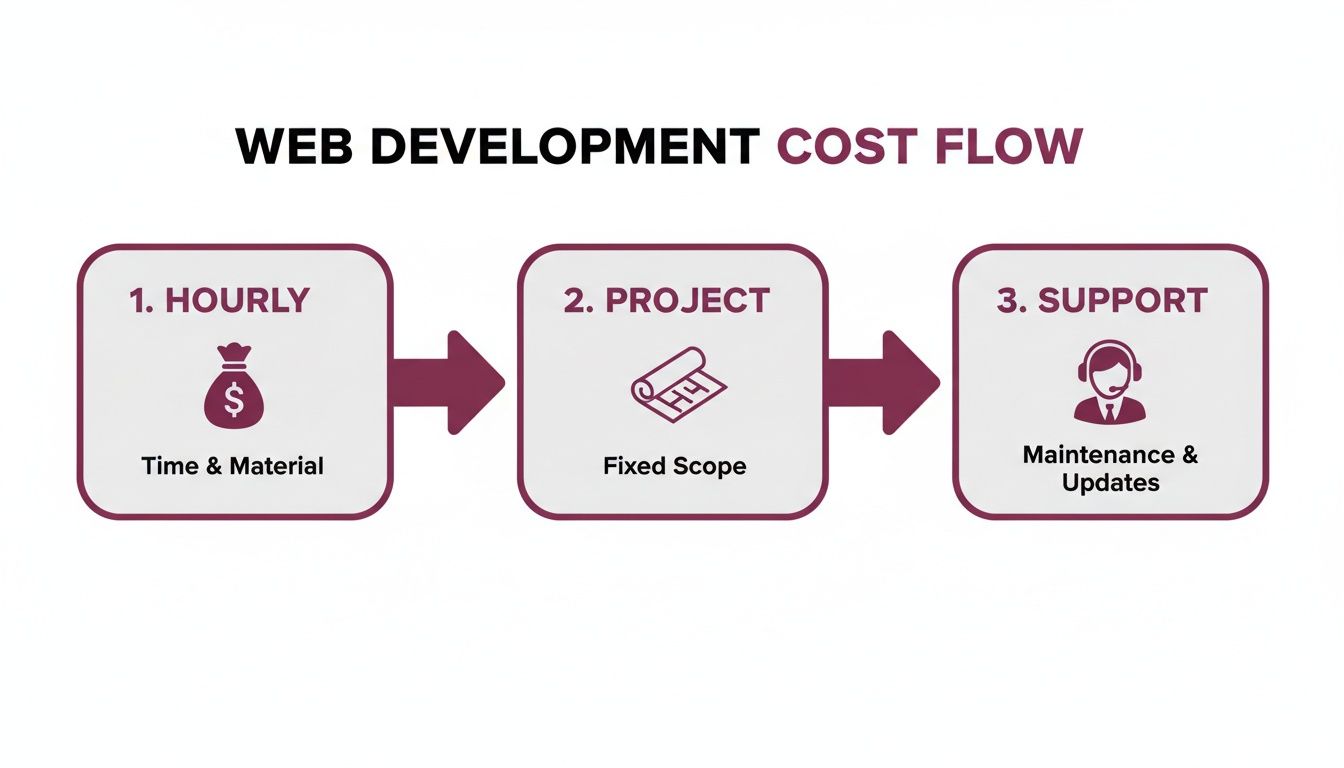
This process highlights that a website is an ongoing investment, with distinct costs for the build phase and for the essential support that follows.
Navigating this process can seem daunting, but it doesn’t have to be. Our dedicated team is here to guide you every step of the way, providing professional advice and ensuring a smooth, successful launch. If you’re ready to start your journey, just reach out for a free, no-obligation estimate.
A Few Lingering Questions About Hiring a Vancouver Web Developer
Even with a solid plan, it’s normal to have a few questions before hiring a web developer. This is a big move for your business, and you deserve to feel confident. To help, we’ve provided actionable advice for the most common questions we hear from Vancouver business owners.
What Does a Small Business Website Typically Cost in Vancouver?
This is the number one question, and the honest answer is: it depends. For a professional, well-designed website for a small business in Vancouver, a typical range is $5,000 to $15,000. This generally covers a clean, modern site with essential pages like Home, About, Services, and Contact.
If you need advanced features like e-commerce, custom booking systems, or a large amount of content, the investment will be higher.
Our suggestion: always ask for a detailed, itemized quote so you know exactly where your money is going. If you’re unsure what your budget should be, we can provide a free, no-obligation estimate to give you a clear financial picture based on your specific needs.
How Long Will It Take to Build My New Website?
While a great website is worth the wait, a realistic timeline is key. For a standard small business site, a 6 to 12-week timeframe is a healthy expectation. This allows enough time for proper strategy, design, development, and testing.
The biggest factor influencing this timeline is you. Projects move fastest when clients provide timely feedback and have their content (text, photos, etc.) ready. Clear communication between you and your development team is what keeps everything on track.
Actionable Tip: To get a head start, gather all your content before the project kicks off. If you have your text and images ready, your developer can plug them in as soon as the design is approved, which can shave a surprising amount of time off the schedule.
Do I Really Need a Developer Who’s Based in Vancouver?
You could hire someone from anywhere, but there’s a huge advantage to working with a Vancouver website developer. A local team lives and breathes this market. They understand the local customer base, see what your competitors are doing, and have real-world experience getting businesses to rank in local Vancouver search results.
That on-the-ground insight is priceless. A Vancouver-based agency can build a digital strategy that truly connects with a Lower Mainland audience, giving you an edge an out-of-town provider can’t match. They understand the unique vibe of neighbourhoods from Kitsilano to Burnaby and know how to turn that local knowledge into a more powerful online presence.
What’s the Difference Between Hiring a Freelancer and an Agency?
This choice comes down to the size and scope of your project.
- A Freelancer is a one-person show, often specializing in a specific area like WordPress or graphic design. For smaller, straightforward projects or a single task, a freelancer can be a great, cost-effective option.
- An Agency brings a full, dedicated team to the table. You get a strategist, designer, developer, SEO expert, and project manager all working together. This integrated approach is perfect for more complex websites that require a comprehensive solution and ongoing support to thrive.
Ultimately, the right answer depends on what your project demands.
At Sugar Design Group, we don’t just build websites; we build partnerships. Our dedicated team is here to offer the professional guidance and support your business needs to succeed online. If you’re ready to get started, just reach out today. We’re here to help with a free estimate and professional advice for your project.