

Picking a web design company in Vancouver can feel like a huge task. The city is a hotbed for tech talent, which is great, but it also means you’re swimming in a sea of agencies, freelancers, and niche specialists. The real secret isn’t just finding a good designer—it’s about finding the right kind of partner for what your business actually needs to achieve. Our dedicated team is here to help you navigate this process with professional advice and clear, actionable insights.
Decoding the Vancouver Web Design Market
Before you start looking at portfolios, you need to understand the local scene. Vancouver is a major Canadian tech hub, and that means we have a crowded, competitive market full of web design firms. You’ll find everything from small shops perfect for a Gastown café to large agencies that handle national brands.
Just how competitive is it? A quick look on a platform like Clutch.co shows 491 web design companies serving Vancouver. While not all are physically here, a huge number are based right in the city or the Lower Mainland. This boom is no accident; it’s a direct reflection of Vancouver’s tech growth, making a solid web presence non-negotiable for any local business.
Finding Your Ideal Agency Match
The good news is that you can simplify your search by sorting these agencies into a few key categories. Getting a handle on who does what will help you zero in on the partners who can actually help you succeed and avoid wasting time with the ones who can’t.
Think of the market like this:
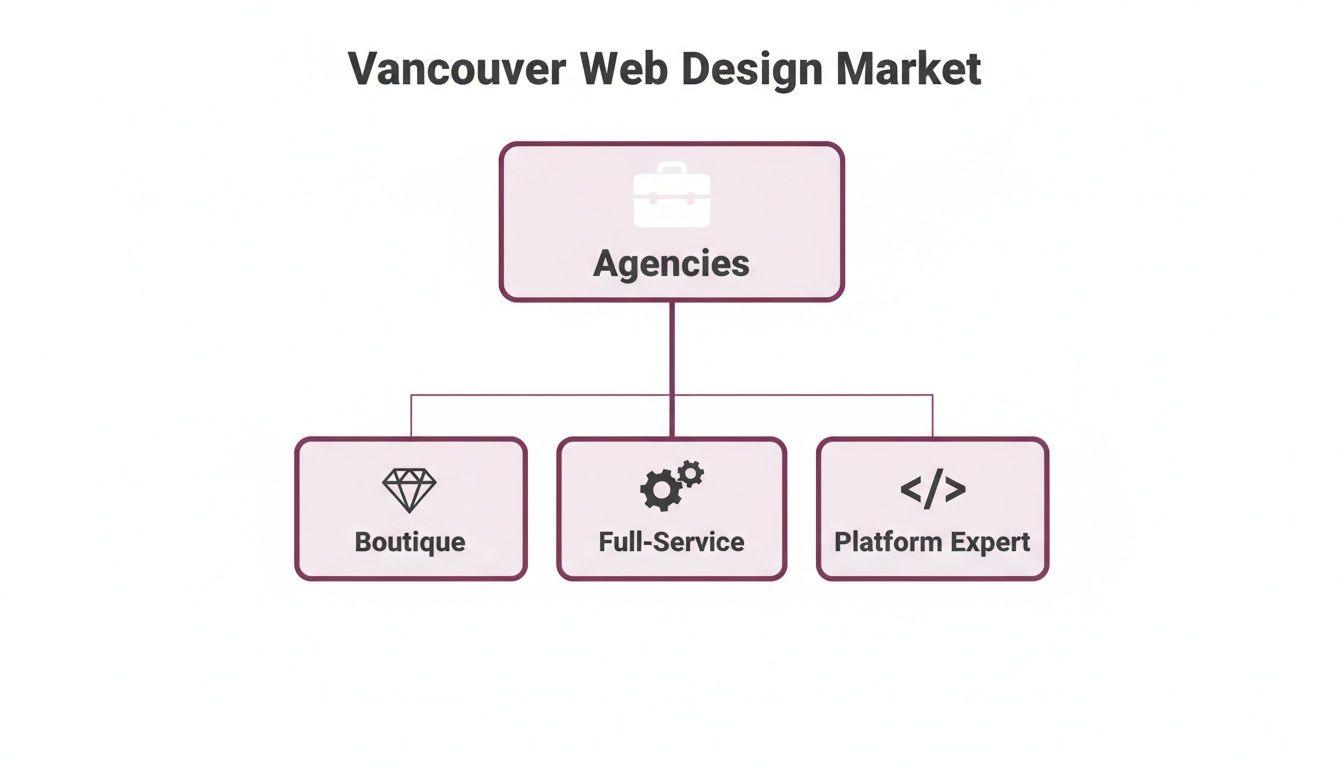
This breakdown shows how different agencies specialize. Each model offers unique strengths, and the best fit really depends on your project.
Let’s dig a little deeper into the main types you’ll encounter:
- Boutique Specialists: These are the small, focused teams that go deep on one thing. They might be masters of user experience (UX) design, brilliant at branding for creative industries, or the go-to experts for a specific sector like real estate or hospitality. Expect a very personal, hands-on approach.
- Full-Service Digital Agencies: These are your one-stop shops. They’re typically larger and do much more than just build websites. Think SEO, paid ads, content marketing, and social media management, all under one roof. They’re a great choice if you want a single partner to handle your entire digital strategy.
- Platform Experts: Some agencies live and breathe a specific technology. You’ll find Shopify gurus for e-commerce, WordPress wizards for content-rich sites, and Webflow pros for crafting stunning, custom-designed experiences.
The right agency for you hinges entirely on your business goals. If you need to sell products online, talking to a Shopify expert just makes sense. But if you’re a local service business trying to get leads, you need an agency that can prove they know local SEO inside and out.
The following table breaks down these agency types to help you see where your needs might fit.
Vancouver Web Design Agency Types at a Glance
This comparison of different agency models will help you identify the best fit for your project needs and business goals.
| Agency Type | Best For | Typical Services | Our Approach at Sugar Design Group |
|---|---|---|---|
| Boutique Specialist | Businesses needing deep expertise in a specific area like UX, branding, or a particular industry (e.g., real estate). | Niche design services, brand identity, user experience optimization, industry-specific website features. | We are a boutique agency specializing in lead-generation websites for local service businesses in Vancouver. |
| Full-Service Digital Agency | Companies looking for a single partner to manage their entire online presence, from design to ongoing marketing. | Web design & development, SEO, PPC advertising, content creation, social media management, email marketing. | We integrate our web design with a strong focus on local SEO and conversion optimization from day one. |
| Platform Expert | Projects that are heavily reliant on a specific technology like Shopify for e-commerce or Webflow for design-led sites. | Platform-specific design, app integration, custom theme development, e-commerce setup and optimization. | We are platform-agnostic, choosing the best technology (like WordPress or Webflow) that aligns with our client’s goals. |
Understanding these distinctions is the first real step toward finding a great partner. It means that when you do start having conversations, they’ll be productive right from the get-go.
If you’re still not sure which direction to take, don’t worry. Our team is here to help you get clear on your goals. Just reach out for a free estimate, and let’s talk about your project.
Defining Your Project Scope and Budget
Before you start reaching out to web design agencies in Vancouver, the single most important thing you can do is get crystal clear on what you actually need. A well-thought-out project scope is your best friend in this process. It cuts through the noise, helps you get accurate quotes you can actually compare, and sets the stage for a productive partnership from the get-go.
Think of it this way: walking into a conversation with a vague “I need a new website” is like telling a builder you need “a new house.” You’ll get proposals that are all over the map. A detailed scope, on the other hand, puts you in the driver’s seat.

Key Considerations for Your Website Blueprint
To build out your scope, start by mapping out the essential features and functions your website needs to perform. You don’t need to be a tech wizard for this—it’s about defining what job you’re hiring your website to do for your business. Our team can help you with this, but here are a few core areas to think through:
- E-commerce Functionality: Are you planning to sell products directly from the site? How many? Will you need things like customer accounts, recurring subscriptions, or integration with a specific payment processor like Stripe or Moneris?
- Custom Integrations: Does your website need to talk to other software you rely on? This could be anything from a CRM like Salesforce, an email marketing tool like Mailchimp, or specialized booking software for your industry.
- Content Management: How often will you be updating the website? Do you need an easy-to-use blog, a portfolio to showcase your work, or a calendar for upcoming events? A simple Content Management System (CMS) is a must for most businesses.
- Long-Term Marketing Goals: What’s the main purpose of the site? Is it to generate leads, drive online sales, or establish your brand as an industry authority? The answer here will influence everything from the layout to the calls-to-action.
For businesses with more complex operations, off-the-shelf solutions might not cut it. If your model requires unique features, exploring something like custom web application development can unlock powerful new ways to automate processes and serve your customers better.
Demystifying Web Design Costs in Vancouver
With a solid scope in hand, you can confidently start thinking about the budget. Let’s be honest, price is often the most intimidating part of this whole process, but it really doesn’t need to be. In a market like Vancouver, website costs can vary dramatically, and understanding what’s behind the numbers is key.
As a general rule, what you can expect to pay a professional web design firm in Vancouver aligns with broader Canadian benchmarks. National data suggests a small business website in Canada can run anywhere from CA$1,000 to over CA$50,000. Here in Vancouver, many agencies focus on the mid-market, with project minimums often starting in the CA$1,000–CA$10,000 range and hourly rates sitting around CA$100–CA$149. This has led a lot of local businesses to partner with integrated agencies that bundle services into predictable monthly retainers.
The real difference between a CA$3,000 website and a CA$30,000 one boils down to complexity, customization, and scope. The lower end is likely a straightforward site built on a template, while the higher end probably involves custom design, complex software integrations, and a deep strategic process.
Knowing this helps you frame the conversation realistically. It’s not about hunting for the cheapest quote; it’s about making a smart investment in the right solution for your business goals.
At Sugar Design Group, we believe in being completely upfront about costs. Our team is here to offer professional advice and provide a free, detailed estimate tailored to your specific needs. We’re ready to help you nail down your scope and understand the investment needed to build a website that delivers real results. Just reach out, and let’s start the conversation.
How to Evaluate a Web Design Portfolio
A web design company’s portfolio is their resume, their proof of work, and your best window into what they can actually do. It’s more than just a gallery of pretty pictures. It’s where you get a real feel for their problem-solving skills, their design sense, and, most importantly, their track record of getting real results for businesses like yours.
Don’t just scroll through the homepage screenshots. The real work begins when you click through to the live client websites. Put yourself in the shoes of a customer. Does the site work the way you’d expect? Is it intuitive? This is your chance to see if they practice what they preach.
Your job here is to look past the surface and really critique the user experience from top to bottom. A truly great design is almost invisible because everything just works.
Looking Beyond Pretty Pictures
When you land on a site in a portfolio, it’s natural to first judge how it looks. But while a great-looking site is important, it’s only half the story. The best websites are a perfect marriage of form and function, built to guide visitors toward a specific goal without any friction.
To properly vet an agency’s work, you need a simple framework.
Here’s an actionable suggestion: start with these fundamental technical checks on a few of their projects:
- Mobile Responsiveness: Seriously, pull up the website on your phone. Does the layout automatically adjust? Are the buttons big enough to tap easily? Can you read the text without pinching and zooming? With more than half of all web traffic coming from mobile, a seamless mobile experience isn’t a “nice-to-have”—it’s essential.
- Loading Speed: How fast does the site load? Don’t just guess. Use a free tool like Google’s PageSpeed Insights to get an actual performance score. A slow website is a frustrating website, and that hurts both user experience and search rankings. A good agency’s portfolio should be full of fast, optimized work.
- Intuitive Navigation: Can you find what you’re looking for in just a couple of clicks? The menu should be clear and logical. If you feel lost trying to find their contact page or a list of services, that’s a huge red flag.
As you’re clicking around, look for solid evidence of modern user experience design principles. A site that’s genuinely easy and even pleasant to use is a clear sign that the agency knows how to build for people, not just for search engine bots.
Searching for Evidence of Real Results
An impressive portfolio doesn’t just show off cool designs; it tells success stories. The best web design company vancouver will use its portfolio to prove how it has helped businesses achieve real, tangible goals. This is what separates a simple design shop from a true growth partner.
Look for case studies, not just a grid of images. A proper case study should walk you through the project from start to finish, outlining the client’s initial problem, the agency’s strategy, and the measurable results they delivered.
Don’t get star-struck by a portfolio full of big-name brands if they aren’t relevant to your business. An agency that helped a local Vancouver service company double its online leads is far more valuable to you than one that built a microsite for a global corporation.
As you review their work, keep asking yourself these questions:
- Industry Relevance: Have they worked with businesses in your industry or of a similar size? Understanding the unique challenges of your market is a massive advantage.
- Measurable Outcomes: Do their case studies talk about specific results? Look for hard numbers like “increased website traffic by 40%,” “boosted online sales by 25%,” or “grew lead generation through the contact form.” Vague claims are a warning sign.
- Problem-Solving: Do they clearly explain the problem they were hired to solve? This shows they take a strategic approach instead of just slapping a pre-made template on a new project.
Digging into a portfolio this way takes a bit of time, but it’s probably the most important step in finding a partner who can actually deliver the results you’re paying for. If you happen to be looking at our portfolio, we’d want you to look for these exact things—the stories of growth we’ve helped create for other Vancouver businesses.
If you want a professional eye to help you assess your options or want a dedicated team to review your current website, just get in touch. We offer a free estimate and are always happy to provide expert advice to help you make the right choice.
Essential Questions to Ask Before You Hire
Your first meeting with a potential web design company is more than just a sales pitch. It’s your best shot at figuring out if they’re the right long-term partner for your Vancouver business. To really get value from this time, you need to go beyond the obvious “How much does it cost?” question. This is where you dig into their process, how they communicate, and what they really know.
A great agency won’t just build what you ask for; they’ll push back a little. They’ll ask you tough questions to make sure the website they build actually solves your business problems and fuels your growth.

Uncovering Their Process and Communication Style
Understanding how an agency actually works day-to-day is crucial for a smooth project. If your expectations for communication don’t match their reality, things can go sour fast. You need clarity here before you sign anything.
A simple but vital question is, “Who will be my main point of contact?” Having to chase down multiple people is a recipe for confusion and delays. A single, dedicated contact keeps things simple and builds a solid relationship.
Next, get into the nitty-gritty of their workflow with these actionable questions:
- What’s your process for kicking off a new project?
- How often will I hear from you with progress updates?
- What tools do you use for project management and communication (like Slack, Asana, etc.)?
- How do you handle feedback and revision requests from my team?
A confident agency will have straightforward, well-practised answers. If their responses are vague, that’s a big red flag that their process might be just as messy.
Probing Their Technical and Strategic Expertise
Alright, let’s get into the technical stuff. You don’t need to be a coding expert, but you do need to feel confident in their technical recommendations and the reasoning behind them. This is where you can truly separate a good web design company vancouver from a great one.
A fantastic place to start is, “Which platform (like WordPress, Shopify, or Webflow) do you recommend for me, and why?” Their answer should connect directly to your business goals, not just what they prefer to build on. For instance, they should be able to justify Shopify for its powerful e-commerce tools or WordPress for its unmatched flexibility with content.
A top-tier agency doesn’t just build websites; they build strategic business assets. Their technical choices should always be justified by how they help you achieve your goals, whether that’s increasing sales, generating leads, or improving operational efficiency.
It’s also essential to ask how they handle data and ensure compliance with regulations like Canadian data privacy laws. This shows they’re thinking about your business’s legal responsibilities, not just the design.
Essential Agency Vetting Checklist
To help you stay organized during your consultations, we’ve put together a checklist of must-ask questions. Use this table to make sure you cover all the critical areas and can compare agencies effectively.
| Category | Core Question to Ask | What a Good Answer Sounds Like |
|---|---|---|
| Project Management | Who will be my single point of contact throughout this project? | “You’ll be assigned a dedicated Project Manager who will be your go-to person for everything from start to finish.” |
| Communication | What’s your standard frequency and method for project updates? | “We provide a weekly progress report via email and use a shared Slack channel for any quick questions that come up.” |
| Technology | Which web platform do you recommend for my specific business needs, and why? | “Based on your e-commerce goals, we recommend Shopify for its secure checkout and inventory management. For a content-heavy site, we’d suggest WordPress.” |
| Post-Launch Support | What do your ongoing maintenance and support plans look like? | “We offer several monthly plans that include security updates, performance monitoring, and a set number of support hours.” |
| Ownership | Who owns the final website, design files, and all associated accounts once the project is paid for? | “You do. We transfer 100% ownership of all assets, accounts, and intellectual property to you upon final payment.” |
| Training | Will you provide training for my team to manage the site’s content? | “Absolutely. We include a one-on-one training session via video call and provide custom documentation for your team to reference.” |
This checklist isn’t exhaustive, but it provides a strong foundation for a productive conversation, helping you identify a partner who is organized, transparent, and truly invested in your success.
Clarifying Long-Term Support and Ownership
Launching a website is just the beginning. You need a clear picture of what happens after the site goes live. This is where you need to ask about ongoing support, maintenance, and, most importantly, ownership.
Get direct answers to these questions to avoid any nasty surprises down the road:
- Do you offer ongoing website maintenance plans? What’s included?
- Who owns the website and all its files when the project is done? (The only right answer here is you).
- Will you train my team so we can update content ourselves?
The right agency will be an open book. They’ll empower you with full ownership and the skills to manage your new digital asset while offering reliable support for the technical side of things you shouldn’t have to worry about. Our dedicated team is ready to help you with this, just reach out for professional advice.
Why Local SEO Is Critical for Vancouver Businesses
Let’s be honest. For any Vancouver business, a stunning website is only part of the puzzle. If a potential customer in your neighbourhood can’t find you the moment they need your services, that beautiful site might as well be invisible.
This is where Local Search Engine Optimization (SEO) comes in. Think of it as the engine that connects your business to the people in your community who are actively looking for exactly what you offer.
Put yourself in a customer’s shoes. When someone in Kitsilano needs a plumber, they’re not just typing “plumber” into Google. They’re searching for “plumber vancouver” or “plumber near me.” Google gets this. It prioritizes geographically relevant results, pushing the “Map Pack” right to the top of the page. Getting your business into this coveted 3-pack is an absolute game-changer.
Research consistently shows that nearly half of all Google searches have local intent. For any brick-and-mortar shop or service-area business in Vancouver, that’s a massive slice of your potential market. Ignoring local SEO is like having a storefront on Granville Street but keeping the doors locked.
Dominating the Google Maps 3-Pack
Appearing in the Google Maps 3-pack isn’t just a nice-to-have; it’s essential for local visibility. These top three listings get the lion’s share of clicks, often pulling in more traffic than even the top organic search results sitting just below them. Landing here puts your business front and centre, complete with your location on the map, customer reviews, and a direct line to your website.
So, how does Google decide who gets these prime spots? It boils down to a mix of three core factors:
- Relevance: How well your business profile matches the searcher’s query. This is all about using the right business categories and keywords.
- Distance: How close you are to the person searching. You can’t move your office, but you can make absolutely certain your address is listed accurately everywhere online.
- Prominence: How well-known your business is in the real world and online. Google figures this out by looking at your online reviews, local citations (mentions on other directories and websites), and the overall authority of your website’s own SEO.
A common mistake is thinking a Vancouver address is all it takes to rank locally. The truth is, local SEO is an active, ongoing effort. It requires a thoughtful strategy to consistently send strong signals to Google that your business is a trusted leader in the community.
Our dedicated team is ready to help you sort this out. We can provide a free estimate and a quick analysis of your current local visibility to show you exactly where the low-hanging fruit is.
Building Your Website for Local Visibility
This is where the right web design company in Vancouver becomes more than just a vendor—they become a growth partner. Local SEO can’t be an afterthought you tack on once the site is built. It has to be woven into the very fabric of your website from day one. A savvy agency will integrate local signals right into the design and development process.
This goes way beyond just sticking your address in the footer. Here’s some actionable advice: your site should include:
- Location-Specific Service Pages: Think about creating dedicated pages for the neighbourhoods you serve (e.g., “Web Design Yaletown” or “Kitsilano Landscaping”). This helps you capture those hyper-specific local searches.
- A Dialed-in Google Business Profile (GBP): Your GBP is your digital storefront. A top agency will ensure it’s meticulously filled out with your services, high-quality photos, regular posts, and a clear strategy to encourage a steady stream of customer reviews.
- Local Schema Markup: This is a bit of code on the backend of your website that clearly tells search engines important info like your address, phone number, and hours. It removes the guesswork and helps them rank you accurately.
At Sugar Design Group, we see a website’s primary job as being a powerful local marketing engine. It’s why our approach to search engine optimization for Vancouver businesses is baked into every single project we take on. We don’t just build websites; we build local visibility.
If you’re ready to turn your website into a tool that actively brings local customers to your door, our professional team is here to offer advice and support. Reach out, and let’s talk about how we can make sure your business gets found by the people who matter most—your neighbours.
Red Flags to Avoid When Choosing an Agency
Choosing the wrong web design partner can do more than just waste money. It can stall your business growth, lead to endless frustration, and leave you with a website that fails to connect with your customers. To protect your investment, you need to learn how to spot the warning signs before you commit.

Vague Proposals and Unclear Deliverables
A trustworthy agency will provide a detailed proposal that clearly outlines every phase of the project, including specific deliverables, timelines, and costs. Be cautious of any web design company in Vancouver that offers a vague, one-page quote without breaking down the work.
This lack of detail is often a sign of a disorganized process or, worse, a strategy to add unexpected fees later on. Your proposal should be a clear roadmap, not a mystery. It needs to answer what you’re getting, when you’re getting it, and exactly how much it will cost.
High-Pressure Sales Tactics
A good partnership is built on trust, not pressure. If you feel like an agency is rushing you into a decision with “limited-time offers” or aggressive follow-ups, it’s a major red flag.
A professional team will respect your need to conduct due diligence, compare options, and make a decision that feels right for your business. They should act as a consultant, offering advice to help you make an informed choice—not as a salesperson trying to close a deal at all costs.
Promises That Sound Too Good to Be True
In the world of web design and SEO, there are no silver bullets. Be extremely wary of any agency that promises things like “guaranteed #1 Google rankings” or a complex, custom website in an impossibly short timeframe.
These are often signs of inexperience or, worse, a willingness to use unethical “black-hat” SEO tactics that can get your site penalized by Google.
A reputable agency will be realistic and transparent about what they can achieve. They’ll talk about a strategic process for improving your visibility and setting realistic goals, not about magical, overnight results.
Reluctance to Share Client References
A portfolio shows off an agency’s best work, but client references tell you what it’s really like to work with them. An agency that is proud of its client relationships will be more than happy to connect you with past or current clients.
If they hesitate, make excuses, or can’t provide any contacts, consider it a serious warning. This could indicate a history of unhappy clients or failed projects.
The “One-Size-Fits-All” Approach
Every business is unique, and your website should reflect that. A huge red flag is an agency that pushes a single solution or platform for every client without first taking the time to understand your specific goals, audience, and operational needs.
Their first conversation should be full of questions about your business, not a monologue about their preferred tools. A true partner will recommend a technology stack and design strategy tailored specifically to you.
Issues with Ownership and Access
This is one of the most critical red flags. You must have 100% ownership and administrative access to your website and hosting accounts upon final payment.
Some less reputable companies will register everything under their own name, effectively holding your website hostage and making it a nightmare to leave or make changes without them. Clarify this upfront. If an agency’s contract doesn’t explicitly state that you are the sole owner of all assets, walk away.
Dealing with the fallout from this can be an absolute headache. In fact, if you find yourself in a situation where you’re locked out of your own site, our professional website rescue team is here to help you regain control.
Our dedicated team is ready to offer professional advice and a free estimate. We believe in building lasting partnerships based on transparency and a shared commitment to your success.
Got Questions? We’ve Got Answers
We get asked a lot of the same questions by Vancouver businesses trying to figure out their next steps online. It makes sense—building a new website is a big investment. Here are some of the most common ones we hear, and our team is always ready to answer more if you reach out.
How Much Does a New Website Cost in Vancouver?
This is the big one, isn’t it? The honest answer is: it depends. A straightforward website for a local service business might land somewhere between CA$5,000 and CA$15,000. If you’re looking at a full-blown e-commerce store with all the bells and whistles, you could be looking at CA$25,000 or more.
The only way to get a real number is to have a chat about what you actually need. Our dedicated team can put together a detailed, free estimate for you—no cost, no pressure—so you can see exactly where the investment goes.
How Long Does It Take to Build a Website?
For most of the professional business sites we build, you can expect a timeline of about 8-12 weeks from our first meeting to launch day.
Of course, a simpler site can be quicker, while a project with custom programming will naturally take longer. A good partner will give you a clear schedule right from the start, and we make it a point to keep you in the loop the whole way through. No surprises.
Do I Need Ongoing Maintenance for My Website?
Yes, absolutely. Think of it like the tune-ups for your car or the upkeep on a physical storefront. Your website needs regular attention to stay secure, fast, and working correctly.
Most agencies, including us, offer monthly plans. These typically cover essentials like software updates, security monitoring, backups, and sometimes small content tweaks. It’s a small investment to protect your much larger one and ensure your site keeps working for you long after it goes live. Our dedicated team is ready to help you find a plan that fits.
Choosing a web design partner in Vancouver is a big deal. If I can offer one piece of advice, it’s this: find a team that’s transparent, communicates clearly, and genuinely cares about your business goals. That’s how we approach every project.
Will I Be Able to Update the Website Myself?
You bet. We’d never hand over a website that you can’t manage yourself. We build on user-friendly platforms like WordPress or Shopify, which are designed for regular people, not just developers.
Once we launch, we’ll walk you and your team through everything you need to know. You’ll be able to update text, swap out photos, add blog posts, or manage products without having to call for help every time. Our goal is to empower you.
This whole process can feel a bit overwhelming, but you don’t have to figure it all out on your own. The team here at Sugar Design Group is ready to help you build a website that doesn’t just look good, but actually brings in results.
Get in touch with Sugar Design Group for a free estimate and let’s talk about what you need.